About Centrosema brasilianum (L.) Benth.
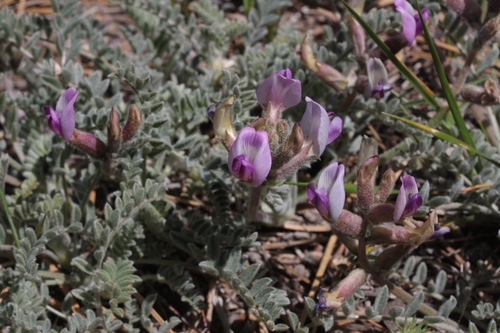
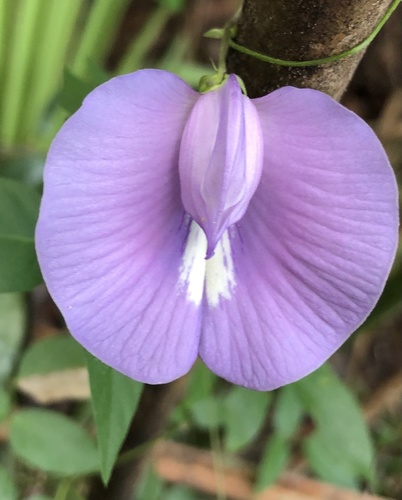
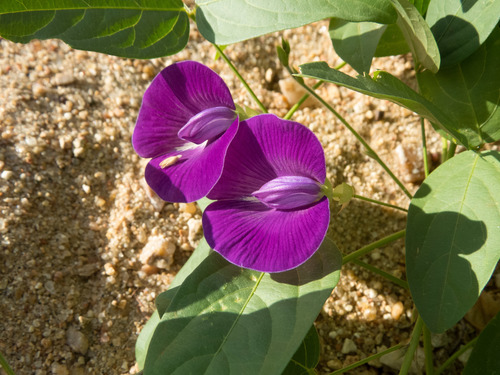
Centrosema brasilianum (L.) Benth. is a perennial herbaceous legume with a growth habit that ranges from prostrate-trailing to twining. Multiple studies have identified both erect and semi-erect forms, and trailing stems produce adventitious roots. Its leaves are trifoliate, with leaflets that are elliptical-oblong, and sometimes ovate, measuring 3.3 to 6.6 cm long and 1.5 to 3.6 cm wide. Flowers are arranged in racemes holding 2 to 5 flowers, though flowers sometimes occur singly. Bracteoles may be either glabrous or pubescent, are ovate in shape, and can be flat or cupped; they range from 3–13 mm long, or in some cases 12–17 mm long and 5–10 mm wide. Peduncles growing from the leaf axils measure 4 to 30 mm in length. The papilionate flowers are typically violet, violet-blue, or red-lilac, and more rarely occur in purple or white. Outcrossing can lead to variation in flower color intensity. The time from sowing to flowering ranges between 3 and 7 months. The pods are linear and dehiscent, measuring 70 to 160 mm long and 4 to 5 mm wide, and contain approximately 8 to 23 seeds. Seeds range in color from dark to light brown, and may sometimes be grey, black, or yellow; they are often striped or spotted, have a cylindrical shape, and measure 3.4 to 4.4 mm long and 2.3 to 3.1 mm wide.