About Centropyge potteri (Jordan & Metz, 1912)
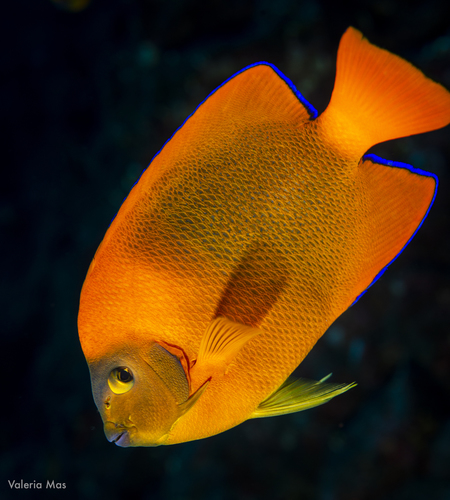
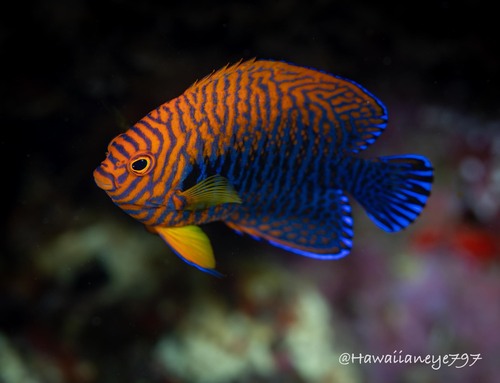
Centropyge potteri has a bright orange body marked with thin vertical blue to black stripes. Its dorsal, caudal and anal fins have a vivid blue margin, while the pectoral and pelvic fins are orange to bright yellow. Males have a wider area of blue in the middle of the body that extends down to the belly. A deep-water vivid blue color morph, with black or purple to burgundy stripes, occurs at depths below 60 metres (200 ft). This species reaches a maximum total length of 10 centimetres (3.9 in).
Centropyge potteri is distributed in the central Pacific Ocean, found around the Hawaiian Islands and Johnston Atoll.
This species occurs at depths between 10 and 120 metres (33 and 394 ft), and lives on rock, coral or rubble areas of seaward reefs. Juveniles are occasionally recorded in waters as shallow as 5 metres (16 ft). It is a benthopelagic species that feeds on algae and detritus. It may live in small social groups, forming harems with one single male and up to 8 females. It is a protogynous hermaphrodite: if no male is present, the dominant female will change sex.
Spawning occurs between December and May, usually around nightfall. A spawning pair selects a high rock outcropping within their territory to spawn over. The male initiates courtship by approaching the female, swimming alongside her vertically with a smooth sinuous motion. He then moves above the female, halts, raises his dorsal and anal fin, flutters his pectoral fins, makes a slight sideward turn, and drifts slowly. If he gets no response from the female, he repeats the entire sinuous swimming sequence until she responds. When both are ready to mate, their red colouration intensifies, and the pair makes audible grunts and clicks. The male then leads the female to the selected outcropping, and continues his display around 90 cm above it. When the female assumes a position indicating she is ready to mate, the male briefly nuzzles her vent until she releases her eggs. The male immediately releases his milt, after which both fish dive for cover. The female then chases the male and nips his caudal fin, before both move to their nighttime shelter.