About Centropyge multispinis (Playfair, 1867)
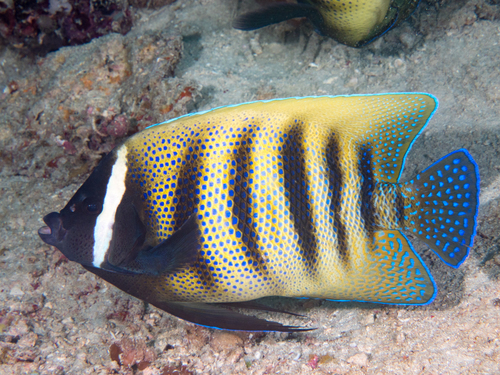
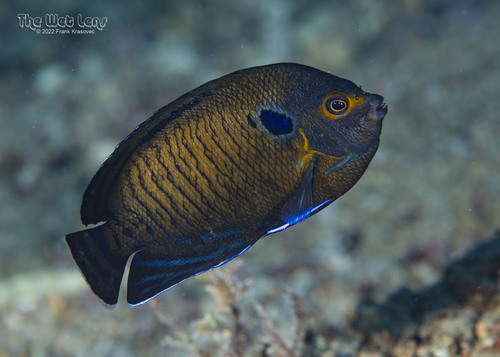
Centropyge multispinis has a dusky-colored body, with black vertical bars along its flanks. The rear parts of its dorsal and anal fins have bright blue edges. The dorsal fin has 14 spines and 15 to 17 soft rays, while the anal fin has 3 spines and 16 to 17 soft rays. This species reaches a maximum total length of 14 centimetres (5.5 in).
Centropyge multispinis occurs in the northern and western Indian Ocean. Its range extends along the eastern coast of Africa, including the Red Sea, and across the Indian Ocean to Thailand and Sumatra. Its occurrence in Madagascar has not yet been confirmed, and a single record from Darwin, Northern Territory is likely a misidentification.
This species is found at depths between 1 and 30 metres (3.3 and 98.4 ft). It lives in areas covered with rubble near coral reefs, and may also be found in lagoon reefs and outer reef slopes. It is one of the most common angelfish species in the Indian Ocean. Its diet consists of algae and detritus. Centropyge multispinis is a protogynous hermaphrodite, meaning it can change sex from female to male. When no male is present in a group, one of the females will change sex to become male.