About Centropyge heraldi Woods & Schultz, 1953
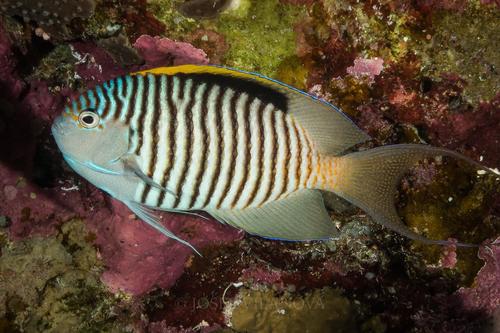
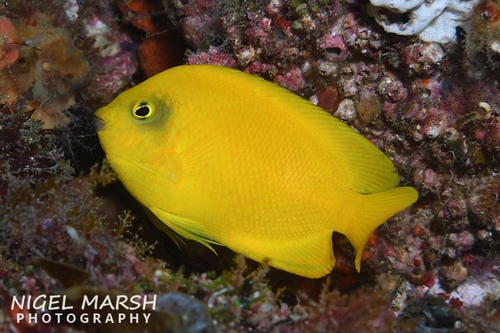
Centropyge heraldi, described by Woods & Schultz in 1953, is a yellowish-orange fish. It has a darker olive patch surrounding the eye, which contains spots that match the body's base color. Its dorsal fin holds 15 spines and 15 soft rays, while its anal fin has 3 spines and 17 soft rays. This species reaches a maximum total length of 12 centimetres, or 4.7 inches. Centropyge heraldi has a wide distribution across the Western and Central Pacific Ocean. Its range extends from southern Japan and Taiwan east to the Tuamotu Islands, and south to Australia. In Australia, the species occurs along the Great Barrier Reef, extending south to the Solitary Islands in New South Wales, and can also be found on some reefs in the Coral Sea. This species lives at depths between 8 and 45 metres, or 26 and 148 feet. It is most often recorded on outer reef slopes, and is occasionally found on lagoon reefs. It typically lives in small harems consisting of one male and one to three females. If no male is present, females can change sex to become male. This is a herbivorous species that feeds on filamentous algae.