About Centropyge flavissima (Cuvier, 1831)
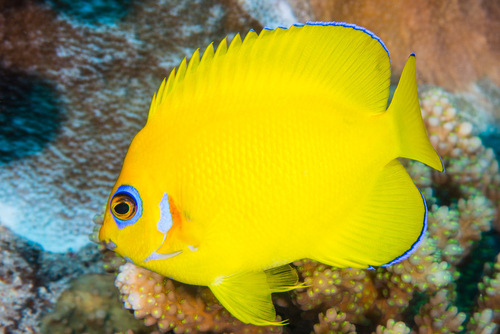
Centropyge flavissima, commonly called the lemonpeel angelfish, has a bright yellow body with a bluish or whitish ring around its eye. A black blotch sits on the rear margin of its gill cover, the spine on its preoperculum is blue, and its dorsal, anal, and caudal fins have blue edges. Juvenile lemonpeel angelfish have a black ocellus with blue edges on their flank. The dorsal fin of this species contains 14 spines and 15 to 16 soft rays, while the anal fin has 3 spines and 16 soft rays. This fish reaches a maximum total length of 14 centimetres, or 5.5 inches. The lemonpeel angelfish is distributed across the Indo-Pacific. The core of its range lies in the Central Pacific, extending from the Ryukyu Islands and Ogasawara Islands of southern Japan in the north, east to the Tuamotu Islands, and south to Australia. It also occurs around some islands in the Indian Ocean. In Australia, it can be found from the northern Great Barrier Reef south to Moreton Bay in Queensland and the Solitary Islands in New South Wales. It is also found off Lord Howe Island in the Tasman Sea, and at Australia's Indian Ocean territories of Christmas Island and Cocos (Keeling) Islands. Records of this species from some parts of the western Pacific Ocean are most likely of vagrant individuals, and it is not found in Hawaii or Johnston Atoll. Lemonpeel angelfish live in shallow water, typically at depths shallower than 20 metres, or 66 feet. They inhabit areas with abundant coral growth in lagoons and on seaward reefs. Juveniles are more secretive than adults. The species is normally found in small groups made up of a single male and multiple females, called a harem. It is a protogynous hermaphrodite: if there is no male in the group, the dominant female can change sex to male, and this change can be reversed. This species feeds mainly on filamentous algae.