About Centropyge bispinosa (Günther, 1860)
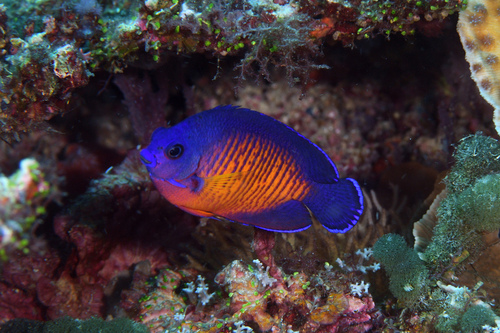
The twospined angelfish, scientifically named Centropyge bispinosa (Günther, 1860), has a base body color of dark purplish-blue. Its flanks are marked with irregular orange vertical bars, and the dorsal, caudal, and anal fins all have a bright blue edge. The dorsal fin has 14 spines and 17–18 soft rays, while the anal fin has 3 spines and 17–19 soft rays. This species reaches a maximum total length of 10 centimetres (3.9 in).
Twospined angelfish are distributed across the Indo-Pacific. Their range stretches from the East African coast between Tanzania and South Africa east as far as the Tuamotu Islands of French Polynesia, north to the Izu Islands of Japan, and south to Lord Howe Island. In Australia, besides Lord Howe Island, this species occurs at the Rowley Shoals and Scott Reef in Western Australia, Ashmore Reef in the Timor Sea, and along the east coast from Raine Island in Queensland to Bass Point in New South Wales, as well as at Christmas Island. Offshore, they can be found at Norfolk Island, Elizabeth Reef, and Middleton Reef in the Tasman Sea, and Ashmore Reef and Kenn Reef in the Coral Sea.
This species inhabits coral reefs at depths between 5 and 50 metres (16 to 164 ft), found in lagoons, rubble patches, and drop-offs, and is most common around drop-offs. They live in small social groups made up of one male and several females. Twospined angelfish are protogynous hermaphrodites: if the existing male in a group dies or disappears, the most dominant female in the group will change sex to become the new male. This species feeds on algae and detritus.