About Centropyge bicolor (Bloch, 1787)
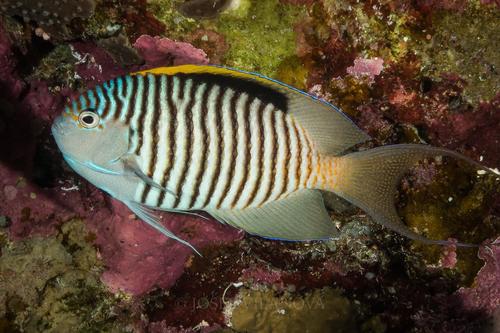
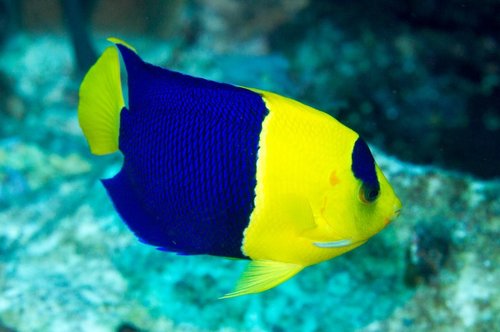
Centropyge bicolor, commonly known as the bicolor angelfish, is a species of marine fish. It is easily recognizable by its yellow tail, yellow front half of the body, blue rear half, and blue patterns above and around the eye. It also goes by the common names Pacific rock beauty, oriole angelfish, oriole dwarf angel, blue and gold angel, and two-colored angel. In the wild, its life expectancy varies greatly depending on location, ranging from 5 to 13 years. Individuals grow to a maximum length of 6 inches, and its larval stage lasts approximately 32 days. This species is most commonly found in the Indo-Pacific region, including East Africa, southern Japan, Australia, the Philippines, and Fiji. It inhabits depths from 1 to 25 meters, and is most often found on reef slopes, in coral areas, in lagoons, and near drop-off areas. A typical bicolor angelfish diet includes small crustaceans (such as brine shrimp and mysis shrimp), tunicates, corals, sponges, worms, and algae, and it will sometimes eat clams. This is a non-migratory species that lives in harems with a single linear hierarchy determined by size. Mature adults are identified by size, and there is no color difference between males and females. During reproduction, males visit the females' home ranges at dusk to mate. A single male may visit one or multiple females to spawn each night. The female scatters her eggs, and the male releases sperm to fertilize them. Females can only spawn a maximum of once per day, and higher-ranking females spawn more frequently than lower-ranking females. In this species' harem social structure, multiple females share one male for mating. Most harems average 7 size-ranked females that all mate with one single male. The male is the dominant member of the group, and females are ranked from largest (highest rank) to smallest (lowest rank). Bicolor angelfish are protogynous hermaphrodites: if the resident male is removed or dies, the highest-ranking female in the harem will change sex to become the new dominant male. This sex change process takes 18 to 20 days total.