About Centropus viridis (Scopoli, 1786)
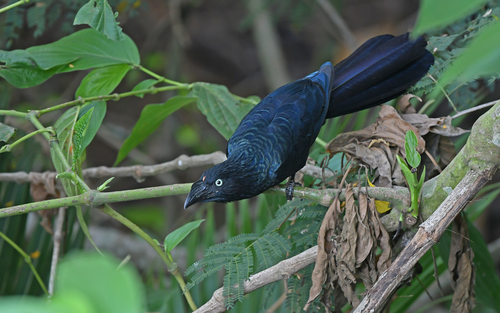
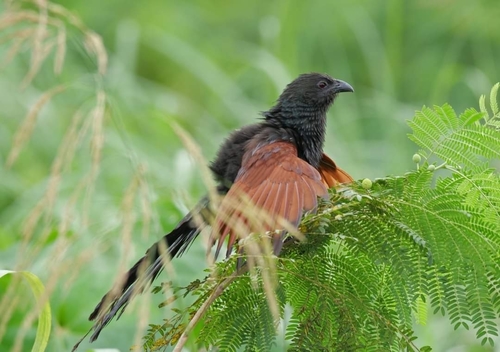
According to EBird, Centropus viridis is a large, long-tailed bird found in open or disturbed areas from lowlands to middle mountain elevations. Its body is entirely black except for rufous wings; a black-winged race occurs on Mindoro, and an uncommon white morph exists on Luzon. It forages for insects and other animal prey on or near the ground. It is similar in appearance to the Black-hooded Coucal, but differs in having a black rather than brown belly and occupying more open habitats. It is much larger than the Lesser Coucal. Its vocalizations include a slightly descending series of repeated "wok!" notes and a short, explosive "jek-wok-wok!"
Its natural habitats are tall grassland, secondary forest, and thickets, occurring up to 2,000 meters above sea level. The IUCN Red List has assessed this species as Least Concern: it has a wide range, tolerates a broad variety of habitats, and actually benefits from human-altered habitats.
In terms of behaviour and ecology, this species feeds primarily on insects, but supplements its diet with small mammals, reptiles, and amphibians. It is most often observed feeding near the ground. It breeds from April to July. It builds a bulky globe-shaped nest from grass, with a single side entrance, placed 1 to 1.5 meters above the ground. The average clutch size is 3 dull white, chalky eggs. Chicks of this species have dark skin.