About Centropus sinensis (Stephens, 1815)
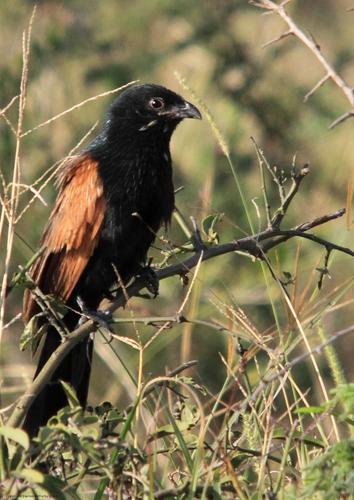
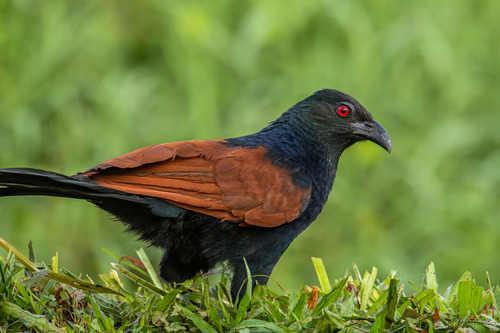
This is the large cuckoo species Centropus sinensis, commonly known as the greater coucal, measuring 48 cm in length. Adults have a black head, with a black purple-glossed upper mantle and underside; the back and wings are chestnut brown, and there are no pale shaft streaks on the coverts. Their eyes are a distinct ruby red. Juveniles are duller black, with spots on the crown and whitish bars on the underside and tail. The sexes have similar plumage, though females are slightly larger, and leucistic specimens have been recorded. Centropus sinensis has several recognized geographic races, and some of these populations are sometimes treated as separate full species. Early taxonomic treatments included the brown coucal Centropus andamanensis under this species name. Rasmussen & Anderton (2005) proposed that the race parroti, found in peninsular India with an unclear northern boundary, may be a full species called the southern coucal. The race intermedius from the Assam and Bangladesh region is smaller than the nominate race found in the sub-Himalayan zone. Songs of the different races vary considerably. The southern Indian race parroti has a black head, blue-glossed underparts, and more brownish color on the forehead, face, and throat. Juvenile parroti have unbarred wings, unmarked dull black undersides (unlike the barred undersides of northern races), and much darker dusky chestnut wings. Between November and January, female race parroti develop dusky or sooty wing coverts; the northern boundary of this race runs along the Punjab plains, where it forms intermediate populations with northern forms. The nominate race is distributed from the Indus Valley through the sub-Himalayan and Gangetic plains to Nepal, Assam, and the Bhutan foothills, extending into southern China (Guangxi, Zhejiang, Fujian). Race intermedius Hume, 1873 is smaller, and occurs in Bangladesh, west Cachar, Myanmar, the Chin Hills, China (Yunnan, Hainan), Thailand, Indochina, and the northern Malay Peninsula. Race parroti Stresemann, 1913 is found in Peninsular India, from Maharashtra, Madhya Pradesh, and Orissa southwards. Race bubutus Horsfield, 1821 occurs in the southern Malay Peninsula, extending to the islands of Sumatra, Nias, the Mentawai Islands, Java, Bali, and Borneo, as well as the western Philippines (Balabac, Cagayan Sulu, and Palawan); this race has paler rufous wings, and has a distinct call. Race anonymus Stresemann, 1913 is found in the southwestern Philippines (Basilan, Sulu Islands), and has shorter, darker wings than race bubutus. Race kangeangensis Vorderman, 1893 is restricted to the Kangean Islands, and occurs in both pale and dark plumage phases. Newly hatched greater coucal chicks have black skin and white hairy feathers called trichoptiles that form a fringe around the eye and beak. The center of a hatchling's belly is pinkish; the upper mandible is black with a pink edge, the iris is brown, the gape is yellow, and the feet are dark brown-gray. Western Ghats populations of this species are very similar in size to the lesser coucal Centropus bengalensis, but lesser coucals can be distinguished by a stubbier bill, shorter tail, wing tips that extend beyond the tertials, a chestnut wing lining, dark eyes, and a tail with a green/bronze sheen. Greater coucals are large birds that feed on a wide variety of prey and plant matter: their diet includes insects, caterpillars, snails, small vertebrates such as saw-scaled vipers, bird eggs, nestlings, fruits, and seeds. In Tamil Nadu, they have been found to feed predominantly on the snail Helix vittata. They are also known to consume the toxic fruits of Cascabela thevetia, or yellow oleander. In oil palm cultivation areas, they are considered an avian pest because they eat the fleshy mesocarps of ripe oil palm fruits. Greater coucals are most active during the warm hours of the morning and late afternoon. They sunbathe in the mornings, alone or in pairs, perched on top of vegetation with their wings spread out. In southern India, the territory of a nesting pair measures 0.9 to 7.2 hectares, with a mean of 3.8 hectares. Their most common call is a repeated booming low coop-coop-coop, with variation between individuals, and mated pairs sometimes perform calling duets where the female's call is lower pitched. Other calls include a rapid rattling "lotok, lotok ...", a harsh scolding "skeeaaaw", and a hissing threat call.