About Centropus monachus Ruppell, 1837
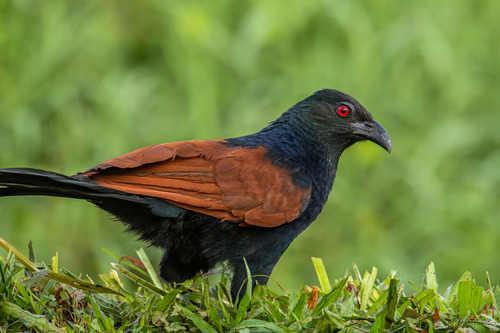
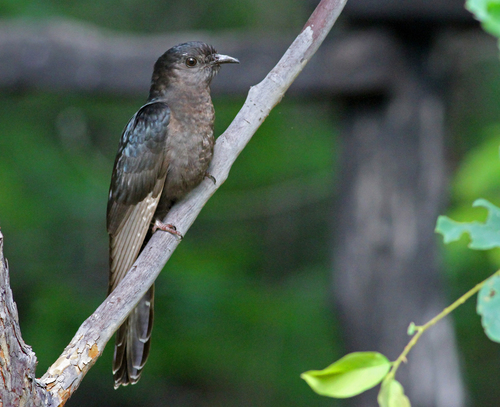
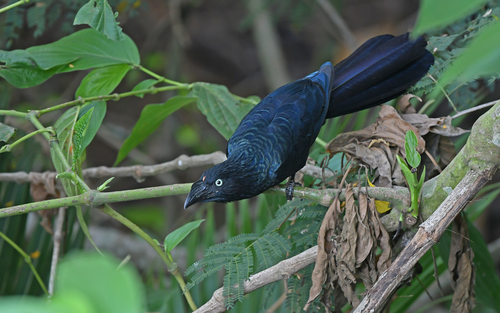
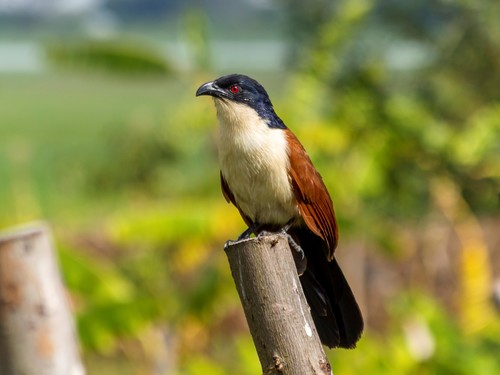
The blue-headed coucal, with the scientific name Centropus monachus Ruppell, 1837, is a medium-sized cuckoo species that reaches a total length of 45 to 52 cm (18 to 20 in). Adult males and females have similar plumage: the head, sides of the neck, and upper back are black with a blue gloss, while the lower back and rump are plain black. The wings are predominantly deep chestnut, and the tail is black with a green or bronze gloss. The underparts of the body are white or pale buff. Adults have dark red eyes, a black beak, and greyish-black legs and feet. Juvenile blue-headed coucals are similar in overall pattern to adults, but their black areas are dull rather than glossy. Juveniles have rufous-buff streaks on the head, dark chestnut wings heavily barred with dark brown, and buff barring on the back and tail. Their throat and breast feathers have black spots. The blue-headed coucal is native to tropical central Africa, where it occurs at altitudes up to 3,000 m (9,800 ft). It generally inhabits higher altitudes than the closely related Senegal coucal (Centropus senegalensis). Documented countries where it occurs include Angola, Benin, Burundi, Cameroon, Central African Republic, Chad, Republic of the Congo, Democratic Republic of the Congo, Ivory Coast, Equatorial Guinea, Eritrea, Ethiopia, Gabon, Ghana, Guinea, Guinea-Bissau, Kenya, Liberia, Mali, Nigeria, Rwanda, Sudan, Tanzania, Togo, and Uganda. Its typical habitats include swamps and marshes, tall grassland, river banks, wet savannah, plantations, secondary growth forest, farmland, and areas around villages.