About Centropus grillii Hartlaub, 1861
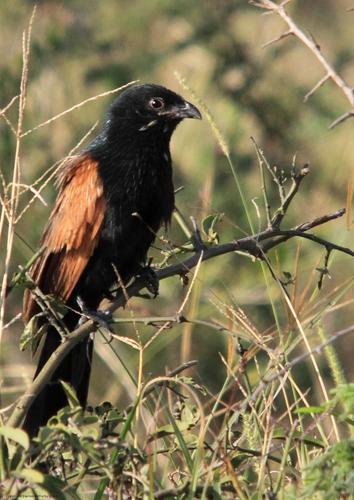
Centropus grillii, commonly known as the black coucal, was first formally described by Hartlaub in 1861. Males measure 30 cm (12 in) in length, while females are larger at 34 cm (13 in); the two sexes are otherwise similar in appearance. In breeding plumage, the head, body and tail are black, with the exception of some buff barring on the rump, and the wings are rufous. Outside of the breeding season, the upper parts of the bird are dark brown with rufous barring. This species has brown eyes, and both its beak and legs are black. Juvenile black coucals are rufous, with a variety of dark and light barring and streaking across their bodies. The black coucal is found across a wide range of African countries: Angola, Benin, Botswana, Burkina Faso, Burundi, Cameroon, Central African Republic, Chad, Republic of the Congo, DRC, Ivory Coast, Eswatini, Ethiopia, Gabon, Gambia, Ghana, Guinea, Guinea-Bissau, Kenya, Liberia, Malawi, Mali, Mozambique, Namibia, Niger, Nigeria, Rwanda, Senegal, Sierra Leone, South Africa, Sudan, Tanzania, Togo, Uganda, Zambia, and Zimbabwe. It is resident in some parts of its range and a migrant in others. Its natural habitat includes marshes, savannah, grassland, bracken, undergrowth, and woodland clearings; it may occasionally be found in stands of reeds or papyrus. It most commonly occurs at elevations below 1,500 m (5,000 ft), though it can occasionally be found as high up as 2,000 m (6,600 ft). This species has reversed sex roles: males tend the nest, while females are polyandrous and maintain territories. Studies of the species' hormonal system have found that progesterone controls the aggressiveness of female black coucals.