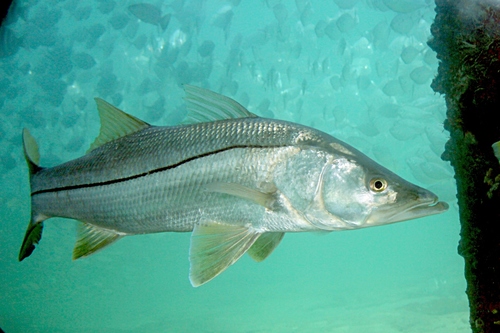
About Centropomus undecimalis (Bloch, 1792)
The common snook, scientifically named Centropomus undecimalis, is a marine fish species that belongs to the family Centropomidae, order Perciformes. It is also known by the common names sergeant fish and robalo. This species was originally placed in the sciaenid genus Sciaena, and the names Sciaena undecimradiatus and Centropomus undecimradiatus are now obsolete synonyms for it. One of the largest snook species, C. undecimalis reaches a maximum overall length of 140 cm (4.6 ft), while its common adult length is 50 cm (1.6 ft). The IGFA all-tackle world record for the species stands at 24.32 kg (53 lb 10 oz), caught at Parismina Ranch, Costa Rica by angler Rafael Montalvo. It has the typical body form of a centropomid, with generally drab coloration aside from a distinct black lateral line. It may also develop bright yellow pelvic and caudal fins, particularly during the spawning season. Common snook is a fish species that depends on estuarine and freshwater habitats. Within estuaries, juvenile common snook most frequently inhabit coastal wetland ponds, island networks, and creeks. Although it is a euryhaline species capable of tolerating a wide range of salinities, young common snook tend to prefer lower-salinity conditions during the early stages of their lives. Through osmoregulation, common snook can adapt and thrive in both high- and low-salinity environments, giving the species a high degree of habitat plasticity. Common snook are opportunistic predators. Their feeding patterns show a positive relationship between their own body size and the size of their prey: as snook grow, they hunt progressively larger prey. They occasionally practice cannibalism, most often during winter when adults and juveniles share close proximity in estuarine habitats. This cannibalism of juveniles by adult members of the species is classified as intercohort cannibalism. Adult common snook that prey on juveniles most likely target them because juveniles are often the largest available prey items in these conditions, making them a nutritionally efficient food source. C. undecimalis is widely distributed across the tropical waters of the western Atlantic Ocean, ranging from the coast of North Carolina south to Brazil, and including both the Gulf of Mexico and the Caribbean Sea. Research suggests snook likely originated in Central America, and historical climate change moved the species into Florida. After the last Ice Age, a major warming trend allowed snook to spread northward along the Mexican coastline, following the Gulf of Mexico perimeter to reach both the west and east coasts of Florida. Very large common snook can be found in Central America; while their appearance differs slightly there due to local climate and water quality conditions, they remain the same species. Most of Central America has no regulations limiting the size or number of snook that can be kept, so local people have harvested and killed these large snook for a long time. The species occurs in shallow coastal waters up to 20 m (66 ft) deep, as well as in estuaries and lagoons, and it often enters fresh water. It is carnivorous, with a diet made up primarily of smaller fish and crustaceans such as shrimp, and occasionally crabs. Because of their limited cold tolerance, common snook are physiologically restricted from living in temperate climates. Historically, the northern edge of the species' range in Florida was around Tarpon Springs on the Gulf Coast and Cape Canaveral on the Atlantic East Coast. Over the past 15 years, common snook have extended their range north as far as the Suwannee River Estuary at approximately 29°N, where their population has increased exponentially. Warmer winter temperatures caused by climate change are thought to be the most likely cause of this range shift. This new colonization by snook may cause food web effects, especially for sea trout of the genus Cynoscion. Common snook is a protandric hermaphrodite fish species. Its spawning season runs from April through October, with peak spawning activity occurring in July and August. Spawning typically takes place in near-shore waters with high salinity. After the spawning period, juvenile snook migrate to the brackish waters of nearby estuarine environments. When these juveniles reach maturity, they return to the higher-salinity open ocean waters to join the breeding population. Common snook, like many fish species, are highly sensitive to changes in their surrounding environment. Even small changes in habitat conditions can produce significant impacts on their behavior. For example, common snook time the start and end of their spawning based on water temperature and salinity, local rainfall amounts, and lunar phases. Environmental disturbances can have severe negative impacts on common snook populations. A key example is the effect of sudden cold snaps, as the species is very vulnerable to cold temperatures. At 14.2 °C (57.6 °F), common snook stop feeding entirely; at 12.7 °C (54.9 °F) they lose the ability to maintain equilibrium; and they die when temperatures drop to 12.5 °C (54.5 °F). A cold snap in January 2010 caused a 41.88% decline in the nominal abundance of the common snook population in southwest Florida compared to the previous year, and a 96 to 97% drop in apparent survival estimates.

