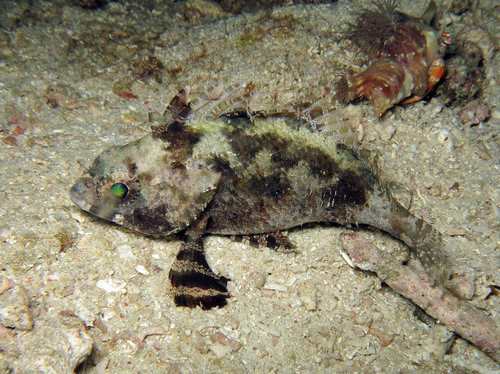
About Centrogenys vaigiensis (Quoy & Gaimard, 1824)
False scorpionfishes (Centrogenys vaigiensis) can reach a maximum total length of 25 cm (9.8 in), though most individuals do not grow longer than 9.3 cm (3.7 in). The operculum, the bony covering that protects the gills, has two spines, and the lower spine is the more prominent of the two. This species has between 36 and 44 lateral line scales. It has 13 or 14 dorsal fin spines, paired with 9 to 11 branched dorsal rays. The anal fin has a short base, and features three spines and five segmented rays, with the second anal fin spine being the longest. Pectoral fins have 12 to 14 rays, while pelvic fins have one spine and three rays; a membrane connects the innermost pelvic ray to the fish's body. The body of this fish is generally pale brown or grey. Fins may match this body color, be lighter, or even be transparent. The ventral (underside) of the body is paler than the dorsal (upper) side. Large brown or grey mottled spots appear on the pectoral and pelvic fins, as well as the forward section of the anal fin. False scorpionfishes prey on small fishes, shrimps, and crabs. This species lives in either brackish or marine water, occupying the benthopelagic zone. Its distribution covers the Indo-West Pacific region, extending from the Nicobar Islands to New Guinea, reaching south to northern Australia and north to the Ryukyu Islands of Japan. False scorpionfishes inhabit rocky bottoms and reefs, almost always in locations with extensive seagrass cover, and are most frequently found in shallow coastal waters.

