About Centrocercus urophasianus (Bonaparte, 1827)
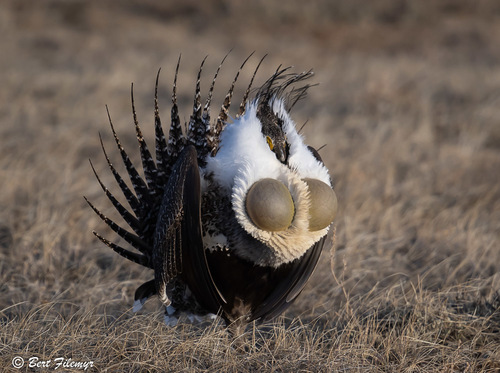
This species has the scientific name Centrocercus urophasianus (Bonaparte, 1827), and is commonly known as the greater sage-grouse. Adult greater sage-grouse have a long, pointed tail, and their legs are covered with feathers all the way down to the toes. Adult males have a yellow patch above each eye, grayish upper body plumage, a white breast, a dark brown throat, and a black belly. During courtship displays, males inflate two yellowish sacs located on their neck. Adult females have mottled gray-brown plumage, a light brown throat, and a dark belly. Adult males measure 26 to 30 inches in length and weigh 4 to 7 pounds. Adult females are smaller, measuring 19 to 23 inches in length and weighing 2 to 4 pounds. Greater sage-grouse are permanent obligate residents of the sagebrush (Artemisia spp.) ecosystem. They most commonly inhabit sagebrush-grassland or juniper (Juniperus spp.) sagebrush-grassland communities. Meadows surrounded by sagebrush are used as feeding grounds, and use of meadows with crown cover of silver sagebrush (A. cana) is especially important for the species in Nevada during summer. Greater sage-grouse are found across the entire range of big sagebrush (A. tridentata), except on the periphery of big sagebrush's distribution. The species prefers mountain big sagebrush (A. t. ssp. vaseyana) and Wyoming big sagebrush (A. t. ssp. wyomingensis) communities over basin big sagebrush (A. t. ssp. tridentata) communities. Sagebrush cover types other than big sagebrush can meet the greater sage-grouse's habitat requirements, and the species may even prefer these other sagebrush cover types over big sagebrush. For example, greater sage-grouse in Antelope Valley, California, use black sagebrush (A. nova) cover types more often than the more common big sagebrush cover types. On the National Antelope Refuge in Oregon, hens with broods were most frequently observed (54–67% of all observations) in low sagebrush (A. arbuscula) cover. Greater sage-grouse may also use desert shrub habitat. Additional sagebrush communities that support greater sage-grouse include silver sagebrush and fringed sagebrush (A. frigida). The species' historic range covered 16 American states, plus the Canadian provinces of Alberta, British Columbia, and Saskatchewan. Between 1988 and 2012, the Canadian population declined by 98%. By 2012, greater sage-grouse had been extirpated from British Columbia, with only small remnant populations remaining: 40 to 60 adult birds in Alberta, and 55 to 80 adult birds in Saskatchewan. By 2013, the species had also been extirpated from five U.S. states. In 2013, the Canadian Governor in Council, acting on behalf of the Minister of the Environment, added an emergency protection order for greater sage-grouse under the Species at Risk Act.