About Centrocercus minimus Young, C.Braun, Oyler-McCance, Hupp & Quinn, 2000
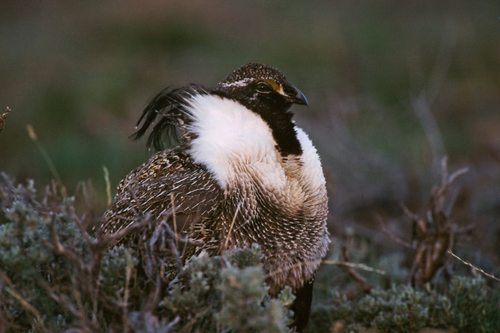
The Gunnison grouse, also called Gunnison sage-grouse or lesser sage-grouse (Centrocercus minimus), is a grouse species endemic to the United States. It is closely related to the greater sage-grouse (Centrocercus urophasianus) and similar in appearance, but is around one third smaller, has much thicker plumes behind the head, and a less elaborate courtship dance. Its range is restricted to southwestern Colorado and extreme southeastern Utah, with the largest population found in Colorado's Gunnison Basin region. Although it is native to the United States, a country where the avifauna is relatively well documented, it was not identified until the 1990s because of its similarity to the greater sage-grouse. It was only formally described as a new species in 2000, making it the first new avian species described from the USA since the 19th century. Recognition of C. minimus as a separate species is supported by a molecular study of genetic variation, which found no gene flow between large-bodied and small-bodied birds in this group. Currently, Gunnison sage-grouse live in seven counties of southwestern Colorado and one county of southeastern Utah. It was historically found in Arizona, New Mexico, and Oklahoma, but is now extirpated from those states. Gunnison sage-grouse are entirely dependent on sagebrush-dominated habitats. Sagebrush is a critical year-round component of the adult diet, and the birds select sagebrush almost exclusively for cover. To rear chick broods, however, the young birds require high-protein broadleaved plants and wildflowers, which also attract insects that provide additional protein. Cattle and sheep also favor these plants, and the loss of these critical chick-food plants is a major cause of this species' population decline. In the life cycle of this bird, males gather on leks (strutting grounds, which are small open areas used for breeding) from late February to April, as soon as the lek is mostly clear of snow. Only a small number of dominant males, usually two, actually breed. After mating, the female hen leaves the lek to go to nesting grounds. Clutch size ranges from six to eight eggs, with an incubation period of 25 to 27 days. Sage-grouse have high rates of nest desertion and nest predation. Chicks are precocial and can feed on their own.