About Centrarchus macropterus (Lacepède, 1801)
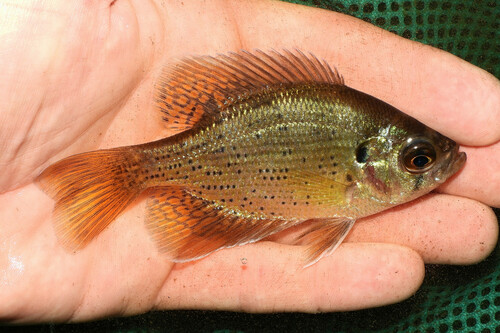
The flier, scientifically named Centrarchus macropterus (Lacepède, 1801), is a small, strongly compressed sunfish species with a moderately sized, oblique mouth. Its dorsal fin has 11–13 spines and 12–14 soft rays, while its anal fin has 7–8 spines and 13–15 soft rays. It has a lateral line, and its scales are ctenoid. The flier’s upperparts are olive-colored, its flanks are marked with scattered dark spots, and its underside is pale. A vertical dark line runs through the eye and continues below the eye in a marking described as a "teardrop". Individuals with a standard length of less than around 45 millimeters (1.8 in) have a distinct dark ocellus (eyespot) with a reddish margin on the soft part of the dorsal fin. The pectoral and pelvic fins are dusky, patterned with paler reticulations. The maximum recorded total length of this species is 29.2 centimeters (11.5 in), though individuals more commonly reach around 13 centimeters (5.1 in), and the maximum published weight is 1.35 pounds.
The flier occurs in the southern United States, along the Atlantic seaboard from the Potomac River drainage in Maryland (where it was most likely introduced) south to central Florida. It is also found in Gulf of Mexico drainages as far west as the Trinity River in Texas, and extends north in the Mississippi River system to above the fall line in southern Illinois and southern Indiana.
Fliers inhabit clear, acidic, heavily vegetated waters, including swamp ponds, sloughs, oxbows, and slow-flowing creeks and streams, with an average water temperature of 23 to 29 °C (73 to 84 °F). They feed mainly on invertebrates such as insects, snails, worms, and leeches, but will also eat smaller fish and some phytoplankton. Breeding typically takes place from March to May, when water temperatures reach 14–17 °C (57–63 °F), though breeding has been recorded as early as February. Gravid females have been collected from a range of habitats, including debris-filled ditches with soft bottoms, gravel-bottomed streams, and heavily vegetated sand and gravel pits. Fliers can spawn in a variety of water conditions, from free-flowing clear or turbid water to stagnant water in ditches and pools. Fliers build nests in rock or gravel, and surround their eggs with a round adhesive egg envelope. They are colonial nesters, nesting in aggregations with nests spaced very close together. They reach sexual maturity at one year old, when they measure 70 millimeters (2.8 in) long. The male parent guards the eggs and newly hatched fry. When frightened or alarmed, fliers seek shelter among aquatic vegetation, submerged tree roots, or mats of floating vegetation.