About Centranthus ruber (L.) DC.
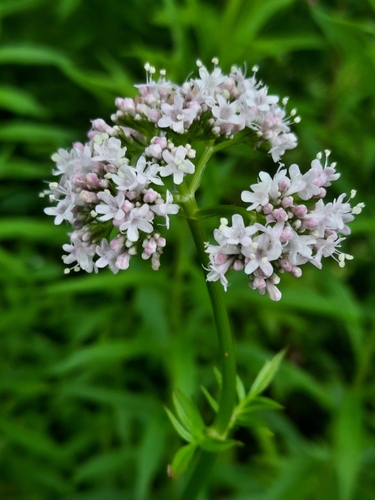
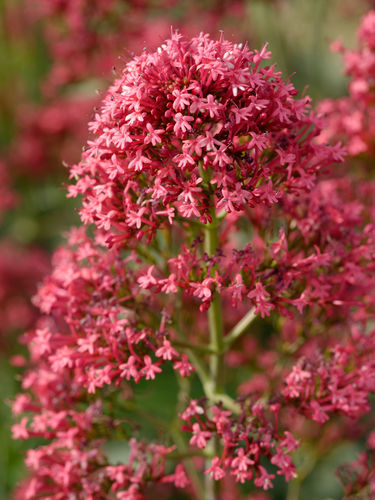
Centranthus ruber (L.) DC. (also referred to as Valeriana rubra, commonly called red valerian) is a multi-stemmed perennial herbaceous plant that grows up to 80 cm (31 in) tall. Its leaves grow in opposite pairs, are oval or lanceolate in shape, and are generally 5–10 cm (2.0–3.9 in) long. Leaves on the main stem are sessile, while leaves on branches sometimes have a petiole that can grow up to 5 cm long. Inflorescences form at the tips of branches, as multiparous cymes that hold a hundred or more flowers. An individual plant produces flowers that are all red, all pink, or all white. Valeriana rubra 'Albus', which makes up about 10% of individuals, has white blooms. The cultivar 'coccineus' is known for being especially long-blooming. The blooms have a strong, somewhat rank scent. They are pollinated by both bees and butterflies, and the plant is noted for attracting insects. Flowering occurs in early summer; in areas with cool summers, flowering continues sporadically throughout the summer into fall. The larvae of some Lepidoptera species, including angle shades, use this plant as a food source. Its fruits have feathery projections similar in appearance to the pappus on dandelion seeds, which allow wind dispersal. The plant can self-seed freely, and can become invasive if not properly controlled. This species is native to the Mediterranean region, with its native range extending from Portugal and Spain to France, Italy, former Yugoslavia, Albania, Greece and European Turkey, and from Morocco to Algeria and Tunisia. It has been introduced to many other parts of the world as a garden escape, and is naturalized in France, Australia, Great Britain, Ireland, the Isle of Man and the United States. In the United States, it grows wild in western states including Arizona, Utah, California, Hawaii, Washington, and Oregon. It most often grows in disturbed, rocky places at elevations below 200 m, and is frequently seen along roadsides or in urban wastelands. It can tolerate very alkaline soil conditions. Because it tolerates alkaline conditions, it can withstand the lime found in mortar, and is often seen growing on old walls in Italy, southern France and south-west UK.