About Centella cordifolia (Hook.fil.) Nannf.
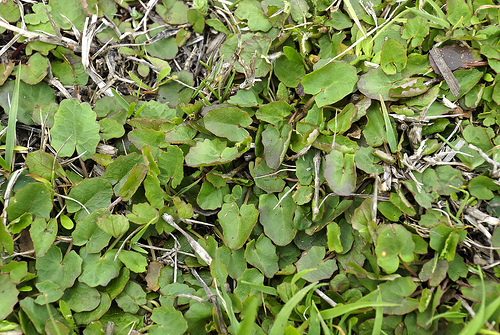
Centella cordifolia (Hook.fil.) Nannf. is a groundcover herb that reaches up to 15 cm (5.9 in) in height and typically spreads 1–2 m (3 ft 3 in – 6 ft 7 in) wide. Its leaves are heart-shaped (cordate), glabrescent, glossy, and dark green. The leaf blade (lamina) measures 1–3 cm (0.39–1.18 in) in length, with a roughly equal width, has five to seven veins and scarious margins. Leaf position changes with light: leaves lie low to the ground in direct sun, and stand upright in shade. The petiole has a purple tint, is sheathing and broad at the base, and can grow up to five times the length of the leaf blade. Flowers grow in ovate, subsessile umbels that are 3 mm (0.12 in) long, with each umbel holding two to three florets. Petals are purple or white, ovate, and around 1.5 mm (0.059 in) long. Sepals form a very small, lobed ring, with two involucral bracts at the base. Anthers are dark purple. Centella cordifolia flowers from late summer (December) to early autumn (March). Its fruit is small, rounded, laterally compressed, and contains seeds. The mericarp has five longitudinal ribs, measures 2.5–3 mm (0.098–0.118 in) long and 4–5 mm (0.16–0.20 in) wide, and is generally glabrous, though small hairs may be present near its apex. Distinguishing Centella cordifolia from other Centella species can be difficult, especially from C. asiatica, which also grows in parts of Australia. Centella cordifolia has more serrate leaf margins, while C. asiatica has more dentate margins. It also has a mat-like growth habit, which sets it apart from other Centella species with more vertically extensive spreading growth habits. Centella cordifolia is native to Australia, where it occurs in parts of Western Australia, South Australia, New South Wales, Victoria and Tasmania. The species has limited recorded occurrences, and its full distribution is not well understood. It grows in damp, poorly drained environments, including marshy soils or shallow water, and tolerates growing conditions from full sun to partial shade. It is intolerant of phosphorus and moderately tolerant of frost. Centella cordifolia has been used to treat rheumatism and arthritis, though there is limited widespread adoption of this use and limited supporting evidence. It is reported to have Indigenous cultural significance, and again, little information is available on this topic. Centella cordifolia is closely related to Centella asiatica, and their uses may be interchangeable. Centella asiatica is widespread across Australia, Africa, Asia, and North and South America, and has well-documented cultural, medicinal, and culinary uses. A 2017 study published in Frontiers in Plant Science compared three Centella species (C. cordifolia, C. asiatica, and C. erecta) and found C. cordifolia to be genetically and chemically similar to C. asiatica.