About Centaurium pulchellum (Sw.) Druce
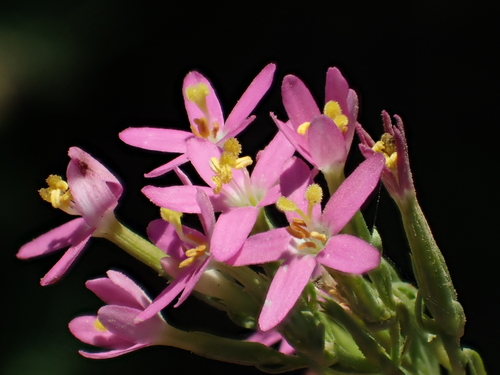
Lesser centaury (Centaurium pulchellum (Sw.) Druce) is an erect annual herb that branches from its base. It is often less than 10 cm (4 in) tall, and is much smaller than the related common centaury (Centaurium erythraea). Occasionally, it consists of only a single stem that bears just one flower. By the time it flowers, which occurs from June to September, it has no remaining basal rosette. Its leafy stem bears opposite pairs of narrow oval leaves. Its inflorescence is a small group of pale pink, star-like flowers. Each flower has a short stalk, a floral tube, and five narrow petals; it measures approximately 1 cm (0.4 in) across, has a flat face, and bears yellow anthers. Like other species in its botanical family, these flowers close in the afternoon. Its calyx is roughly the same length as the fruit, which is a cylindrical capsule. This plant is native to southerly temperate zones of Europe. It occurs mainly in the southern half of the British Isles, and is especially common near the south coast of England. It can grow on a wide range of soil types, from calcareous to mildly acidic. On coasts, it grows in open sandy and muddy turf, most often in saltmarshes, sand dunes, and beside estuaries. Inland, it inhabits unshaded, disturbed habitats including lowland dry open grasslands, heaths, woodland glades and rides, and marl pits. In Morecambe Bay, it occurs at the northern end of its range in saltmarshes, where it grows alongside Juncus gerardii, Juncus maritimus, Blysmus rufus, and Eleocharis quinqueflora.