About Centaurea calcitrapa L.
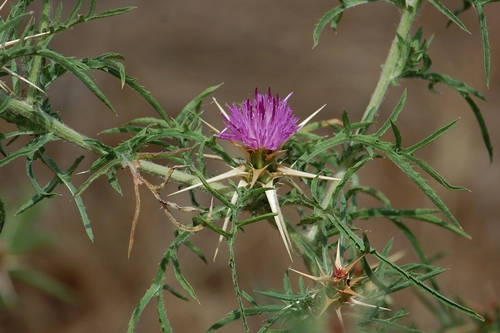
Centaurea calcitrapa L., commonly known as Red Star-thistle, is an annual or biennial plant that grows erect to a maximum height of 1 to 1.3 meters. Its stems are hairless and grooved, and the plant may sometimes grow in a mound shape, with fine to dense hairiness and spines. Its leaves are dotted with resin glands; the lowermost leaves can reach 20 centimeters in length and are deeply cut into lobes. The inflorescence holds a few flower heads, each 1.5 to 2 centimeters long and generally oval in shape. The phyllaries are green or straw-colored, tipped with tough, sharp yellow spines. Each flower head contains many bright purple flowers. The fruit is an achene a few millimeters long that lacks a pappus. This species flowers from July to September, and its seeds ripen from August to October. Centaurea calcitrapa is classified as a Priority Species under the UK Biodiversity Action Plan, listed as vulnerable by UNIC, and recorded as Nationally Rare in the UK Red Data Book. It does not have a national or Sussex Biodiversity Action Plan. Its native distribution includes Albania, Algeria, Austria, the Baltic states, Bulgaria, Cape Verde, Cyprus, Czech Republic, Egypt (Sinai Peninsula), France (including Corsica), Greece (including Crete, the Dodecanese, and the North Aegean islands), Hungary, Iran, Italy (including Sardinia and Sicily), Lebanon, Morocco, Portugal (including Madeira), Romania, Saudi Arabia, Slovakia, Spain (including the Balearic Islands and Canary Islands), Sudan, Syria, Tunisia, Turkey (including East Thrace and the North Aegean islands), Ukraine (including Crimea), and the former states of Yugoslavia. It has been introduced to Australia (South Australia, Tasmania, Victoria), Belgium, Canada (Ontario), France, Germany, Great Britain, the Western Himalaya, Ireland, Netherlands, Norway, Pakistan, Poland, South Africa (Cape Provinces, Free State), Switzerland, Uruguay, and the United States (Alabama, Arizona, California, Washington, D.C., Florida, Georgia, Illinois, Iowa, Maryland, Massachusetts, New Jersey, New Mexico, New York State, Oregon, Pennsylvania, Utah, Virginia, Washington). In western Crete, Greece, a local variety of this species called gourounaki (γουρουνάκι, meaning little pig) has its leaves eaten boiled by local people. In the Vulture area of southern Italy, a southern Italian variety of the species is traditionally consumed by the ethnic Arbëreshë Albanian community. In Arbëreshë communities in Lucania, the young whorls of Centaurea calcitrapa are boiled and fried in mixtures with other non-cultivated weedy greens.