About Cenometra bella (Hartlaub, 1890)
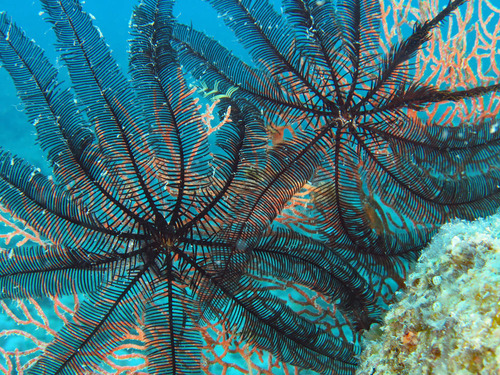
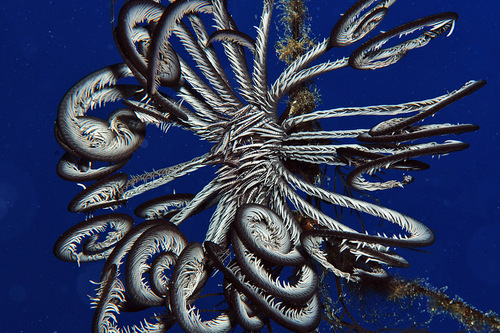
Like many other crinoids, Cenometra bella visually resembles both a flowering plant and a sea star. Over its evolutionary history, this species’ morphology has remained fairly consistent, with minimal changes in outward appearance. These small featherstars are predominantly dark brown on their underside, where their finger-like brachials and cirri are visible; these structures are used for walking and anchoring the animal to objects. The round centrodorsal plate acts as the crinoid’s main body, holding its brachials and arms together, and averages 4.181 millimeters in diameter. The animal’s mouth sits at the center of this plate. C. bella most often has five short, stiff, stout bifurcating arm bases that radiate from the centrodorsal plate of the comatulid ray, though this number can vary between individuals. These arm bases branch into two ossicles, resulting in a total of ten or more free arms. Like in many other members of the order Comatulida, the longer non-branching portion of the arms makes up most of the total arm length. On average, these non-branching feathery arms measure 8.5 centimeters long in adult C. bella. Each arm has a long white central ridge, with dark brown spotted pinnules that project outwards and taper slightly inwards toward the distal end, similar to the fronds of a fern. Not all of a crinoid’s arms are in the process of regeneration, but every individual C. bella has at least a few arms capable of regenerating. Structurally, the brachitaxes are made of two ossicles and have ambulacral appendices. The second pinnule is massive, hard, and curved. The basal segment of the proximal pinnules is either curved or rounded. Cenometra bella typically lives in shallow tropical waters, occupying open surfaces at depths below 5 meters. It is most commonly found around large coral species on coral reefs, and sometimes occurs in the intertidal zone. In rare cases, it has been recorded living in the deeper ocean, at depths up to 55 meters. These featherstars are often found exposed on top of gorgonian corals, under reef flats, or clinging to sea whips. This shallow-water species occurs in the Indo-West Pacific Ocean, and is found across South and Southeast Asia, including in India, the Philippines, China, southern Japan, and the Maldives, as well as in South Pacific Islands and the Great Barrier Reef. Cenometra bella has separate male and female individuals. These gonochoric crinoids release ova or sperm into the water through ruptured pinnules. After fertilization, embryos develop into larvae that later sink to a hard substrate surface, such as gorgonian coral. Once attached to a surface, the growing larvae undergo metamorphosis into small crinoids, and remain mostly sessile while growing.