About Celtis occidentalis L.
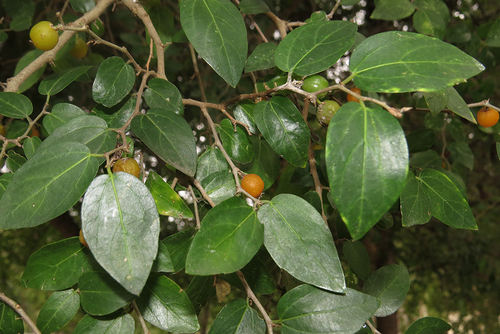
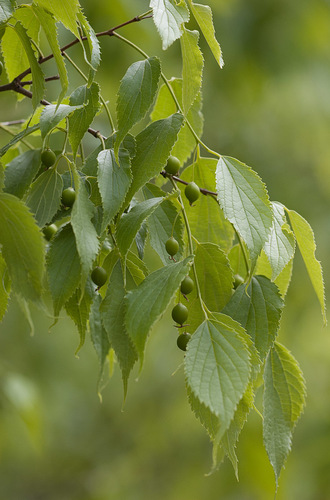
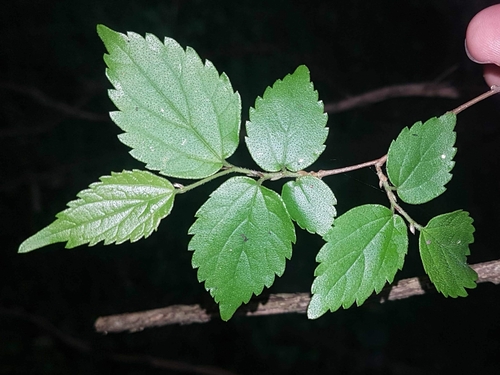
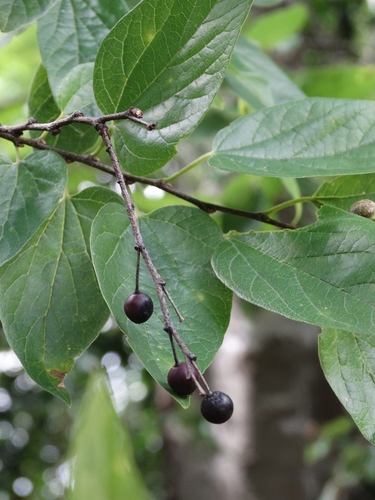
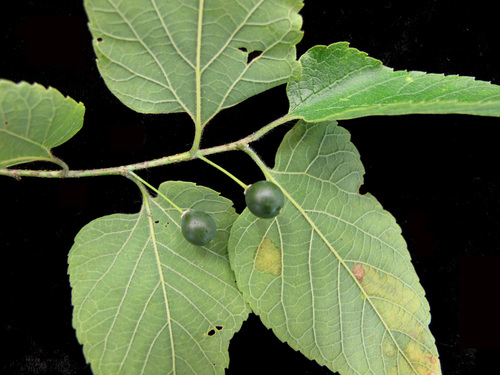
Celtis occidentalis L., commonly known as common hackberry, is a medium-sized tree typically reaching 9 to 15 metres (30 to 50 ft) in height with a slender trunk. In ideal conditions in the southern Mississippi Valley, it can grow as tall as 40 m (130 ft), and in the western part of its native range, trees may still reach up to 29 m (95 ft). In ideal conditions, common hackberry can live between 150 and 200 years. It forms a handsome round-topped crown with pendulous branches, has fibrous roots, and grows rapidly. While it prefers rich, moist soil, it can also grow on gravelly or rocky hillsides. The bark of common hackberry is light brown or silvery gray, with a distinctive surface pattern of thick appressed scales, and is sometimes roughened by excrescences. This unique bark pattern is even more noticeable in younger trees, where irregularly spaced ridges look like long layered sedimentary rock palisades when viewed in cross-section. Valleys between the ridges are deep enough to fit an adult human finger, and U.S. quarter-sized coins can lie flat in these valleys. Slender branchlets change color as they mature, shifting from light green to red brown, and finally to dark red-brown. Winter buds are axillary, ovate, acute, somewhat flattened, 0.25 of an inch long, and light brown. No terminal bud forms; bud scales enlarge with the growing shoot, and the innermost scales develop into stipules. Leaves are alternately arranged on branchlets, ranging from ovate to ovate-lanceolate, often slightly curved, 5–12 cm (2–4 3/4 in) long by 3–9 cm (1 1/4–3 1/2 in) wide. They have a very uneven oblique base, a pointed tip, a serrated (toothed) margin except for the mostly smooth entire base, and three main nerves with a prominent midrib and primary veins. When leaves emerge from the bud, they are folded with slightly rolled margins, pale yellow green, and downy. When fully grown, leaves are thin, bright green and rough on the upper surface, and paler green underneath. In autumn, leaves turn light yellow. Leaf petioles are slender, slightly grooved, and hairy, while stipules vary in form and fall off early. Greenish flowers appear in May shortly after leaves emerge. Common hackberry flowers are polygamo-monoecious, meaning individual flowers can be staminate (male), pistillate (female), or perfect (both male and female). Flowers grow on slender drooping stalks called pedicels. The calyx is light yellow green, five-lobed, divided nearly to the base; lobes are linear, acute, more or less cut at the apex, often tipped with hairs, and overlapping in bud. There is no corolla. Five hypogynous stamens have white, smooth filaments that are slightly flattened and taper gradually from base to apex. In bud, filaments are incurved, holding anthers face to face, and straighten abruptly when the flower opens. Anthers are extrorse, oblong, two-celled, and open longitudinally to release pollen. The pistil has a two-lobed style, a one-celled superior ovary, and contains a single ovule. The fruit is a fleshy, oblong drupe, 1/4 to 3/8 in (0.64 to 0.95 cm) long, tipped with remnants of the style, and dark purple when ripe. It grows on a slender stem, ripens in September and October, and remains on the branches through winter. The endocarp contains significant amounts of biogenic carbonate that is nearly pure aragonite. Common hackberry is native to North America, ranging from southern Ontario and Quebec, through parts of New England, south to North Carolina (Appalachia), west to northern Oklahoma, and north to North Dakota. A small isolated population grows at the southern end of Lake Manitoba. Common hackberry's native range overlaps with sugarberry (Celtis laevigata), which makes it hard to confirm the exact boundaries of each species' range in the southern United States. In the western part of its range, common hackberry is sometimes confused with the smaller netleaf hackberry (Celtis reticulata), which has similar bark, though there is actually little overlap between their ranges. Common hackberry grows in many different habitats, and prefers bottomlands and soils high in limestone. Its shade tolerance depends heavily on growing conditions: in favorable conditions, its seedlings can persist under a closed canopy, but it is considered shade intolerant in less favorable conditions. In ecology, common hackberry leaves are eaten by four gall-producing insect species of the genus Pachypsylla, which do not cause serious damage to the tree. A number of other insects and fungi cause rapid decay of dead branches or roots of the tree. The small drupes, called hackberries, are eaten by many bird species including robins and cedar waxwings, as well as by mammals. Most seeds are dispersed by animals, though some seeds are also dispersed by water. Common hackberry serves as a larval host for butterflies, particularly the hackberry emperor and the tawny emperor. Common hackberry's wood is light yellow, heavy, soft, coarse-grained, and not strong. It rots easily, which makes it undesirable for commercial use, though it is occasionally used for fencing and inexpensive furniture. It is only occasionally planted as a street or landscape tree, even though its tolerance for urban growing conditions makes it well suited for this purpose. Sombor in Serbia and Bratislava, the capital of Slovakia, are known for extensive use of common hackberry as a street tree; in Bratislava it is planted alongside the closely related Eurasian species Celtis australis. In Canada, the city of Montreal has over 10,000 Celtis occidentalis street trees. The tree's pea-sized berries are edible, ripening in early September. Unlike most fruits, the berries are remarkably high in calories from fat, carbohydrate, and protein, and these calories are easily digestible without cooking or preparation. Omaha Native Americans ate the berries casually, while the Dakota used them as a flavor for meat after pounding them finely, seeds and all. The Pawnee also pounded the berries finely, added a little fat, and mixed them with parched corn.