About Celmisia spectabilis Hook.fil.
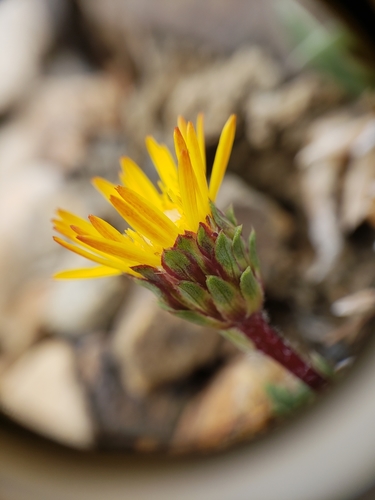
Celmisia spectabilis Hook.fil. is a robust plant with leathery leaves shaped ovate, lanceolate, or narrowly oblong. Mature leaves typically measure 3–18 cm long by 1–2 cm wide. Their upper surface is shiny green and usually nearly hairless, with the only common exceptions being young leaves or leaves from North Island plants. The underside of the leaf is densely covered in soft, whitish or buff-coloured felted woolly hairs. Leaf margins usually roll downwards. Overlapping leaf bases compact together to form a stout pseudostem. Old leaf bases rot slowly, creating a damp mass that can protect young leaves from grass fires. Celmisia spectabilis may grow as a single rosette up to 1 m wide, or grow as multiple rosettes that form mats up to 2 m across. Its flower stems reach 30 cm in height and are densely covered in loose white hairs. Each stem produces one showy solitary flower head at its tip, which measures 3–5 cm across. The numerous ray florets of the flower head are white, while the disc florets are yellow. This species hybridizes with Celmisia lyallii to produce the hybrid Celmisia × pseudolyallii, which resembles C. spectabilis but has longer, narrower leaves. This species occurs in montane to low-alpine regions between 300 and 1700 metres elevation across both of New Zealand's main islands, and is most commonly found in the eastern portions of these islands. In the North Island, it grows south of the Volcanic Plateau and Mount Hikurangi, in tussock grassland and fellfield habitats, and in snow tussock habitat in the Tararua Range. It is not present in eastern Wairarapa. In the South Island, it occurs in higher-rainfall habitats ranging from north-west Nelson to Arthur's Pass. Plants from the Nelson region are smaller and less robust than plants from Canterbury. Nelson populations were previously classified as their own separate variety: Celmisia spectabilis var. angustifolia. However, leaf size increases gradually with increasing latitude, and there is no clear distinct boundary separating these smaller plants from the type. Celmisia spectabilis flowers from early to mid summer. It is pollinated by many different pollinator species, including Melangyna novaezelandiae and Leioproctus.