About Celeus undatus (Linnaeus, 1766)
The waved woodpecker, with the scientific name Celeus undatus (Linnaeus, 1766), measures approximately 23 to 26 cm (9.1 to 10.2 in) in length and weighs 61 to 87 g (2.2 to 3.1 oz).
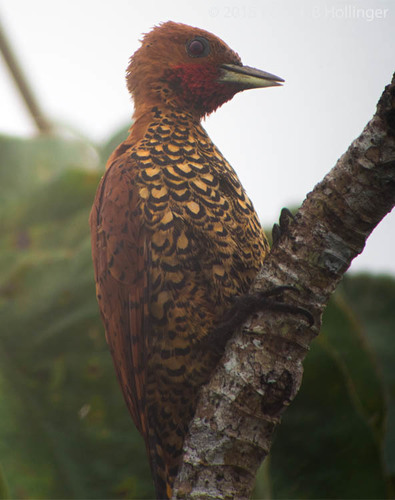
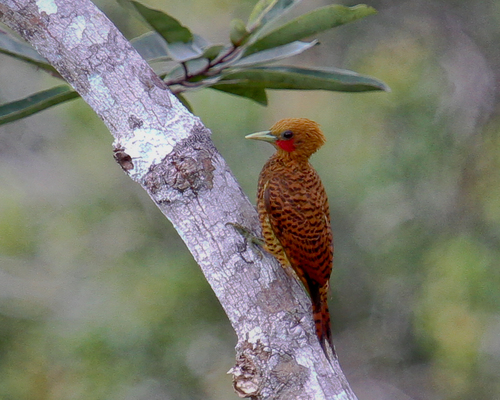
In the nominate subspecies C. u. undatus, both sexes have light chestnut-rufous heads with a bushy crest. The crest is sometimes paler with black bars, and the ear coverts and sides of the neck bear black streaks. Males have a wide red band that runs from behind the bill to the ear coverts, which females do not have. Adult individuals of both sexes have a cinnamon-buff chin and throat marked with black spots or bars. They have rufous-chestnut upperparts with wide black bars, though the rump is usually paler and yellower. Their flight feathers are black with cinnamon-rufous bars. The upper side of the tail is black with rufous bars, and the underside is similar but duller, sometimes with a yellowish tinge. Their underparts are rufous, with the belly lighter than the breast. The breast has irregular wavy black bars, while the belly and flanks have more regular bars. Barring intensity varies between individuals of both sexes, but females generally have heavier barring than males. Adult waved woodpeckers have a relatively short bill that is dull yellow to yellow-green, a red-brown to red iris, and green-gray legs. Juveniles are very similar to adults, but are duller overall and have lighter barring on the upperparts.
Subspecies C. u. amacurensis is darker and more chestnut-colored than the nominate subspecies. Its head is the same shade as its body rather than paler, its rump is cinnamon-rufous with no yellow, its crown has no barring, and all other bars are narrower. C. u. multifasciatus is the largest subspecies. It is paler and more buffy than the nominate, has streaks rather than bars on its head, often has a tail without bars, and has a blackish bill with a pale mandible. Subspecies C. u. grammicus was previously the nominate subspecies of the scaly-breasted woodpecker. For this subspecies, both sexes have rufous-chestnut heads with a pointed crest, and the crest usually has black streaks. Males have a wide red patch from behind the bill to the ear coverts; females lack this patch. Adult individuals of both sexes are mostly rufous-chestnut with a pale greenish-yellow to yellow-buff rump. Their upperparts have narrow black bars that are less prominent on the uppertail coverts. Their flight feathers are blackish with narrow rufous edges and pale greenish-yellow bases. The upper side of the tail feathers is brown-black with chestnut edges and sometimes chestnut bases; the underside of the tail feathers is brown or yellow-brown with cinnamon bases. Their underparts are rufous-chestnut with paler flanks that can be yellowish buff. The breast has black bars and the belly has sparse black spots. Adult C. u. grammicus have a shortish bill that is greenish to yellow-green or ivory, a red iris, and dark greenish gray to gray legs. Juveniles are very similar to adults but have darker heads and paler upperparts with wider bars.
Compared to C. u. grammicus, subspecies C. u. verreauxii has lighter barring on its underparts. C. u. subcervinus has more cinnamon coloring on its rump and flanks, with no yellow tone. C. u. latifasciatus has pale cinnamon upperparts with visible yellow to buffish feather bases, and its rump is very pale. Its mantle has wider bars than C. u. grammicus, and its underparts are much paler.
The distribution of the waved woodpecker subspecies is as follows: C. u. amacurensis is found in Delta Amacuro state, northeastern Venezuela; C. u. undatus is found in eastern Venezuela, Guyana, Suriname, French Guiana, and northeastern Brazil north of the Amazon and west of the Rio Negro; C. u. multifasciatus is found in northeastern Brazil south of the Amazon, between central Pará and Maranhão; C. u. verreauxii ranges from south-central Colombia into eastern Ecuador; C. u. grammicus ranges from southeastern Colombia and southern Venezuela south to northeastern and eastern Peru and western Brazil as far east as the lower Rio Negro and Rio Purus, and also occurs in French Guiana; C. u. subcervinus is found in Brazil south of the Amazon between the Rio Purus and the Rio Tapajós, and extends south into Mato Grosso; C. u. latifasciatus is found in southeastern Peru, southwestern Brazil, and northern Bolivia.
The waved woodpecker primarily inhabits various wooded landscapes, including the interior and edges of rainforest, terra firme and várzea forest, secondary forest, and treed savannah. Across most of its range, it occurs between 100 and 900 m (300 and 3,000 ft) in elevation, and is found locally as high as 1,140 m (3,700 ft); in Ecuador, it reaches only 500 m (1,600 ft).