About Celeus torquatus (Boddaert, 1783)
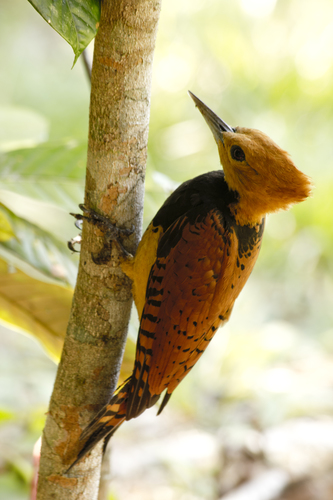
The ringed woodpecker, Celeus torquatus, measures 26 to 29 cm (10 to 11 in) in length. Among its three recognized subspecies, the nominate C. t. torquatus weighs 107 to 124 g (3.8 to 4.4 oz), while C. t. occidentalis weighs 122 to 135 g (4.3 to 4.8 oz); no weight data is available for C. t. tinnunculus. All subspecies of both sexes have a pale cinnamon head with a rufous tinge and a moderately bushy crest. The only difference between sexes is in facial markings: adult males of all subspecies have a red patch extending from the malar area to under the ear coverts, and sometimes have small amounts of red on other parts of the head, while females have no red on the head at all. Adults of the nominate subspecies have solid black lower throat, breast, and upper mantle. Their upperparts, from the lower mantle to the uppertail coverts, are rufous brown. They usually have a small number of black feathers on the lower mantle, plus black marks and bars on the wing coverts. Their flight feathers are barred with black and rufous; primaries have blackish brown tips, while secondaries have a greater proportion of rufous. Their tail is rufous with narrow black bars and a wide black tip, and their underparts are unmarked cinnamon-buff. All subspecies share the same bill, eye, and leg characteristics: the bill is long, with a maxilla in various shades of gray or brown and a mandible that is grayish white or greenish yellow. The iris is red to red-brown, and the legs are gray brown or dark gray. Juvenile ringed woodpeckers resemble adults, but have more black on the face and more extensive barring on the upperparts. Subspecies C. t. occidentalis has a somewhat darker head than the nominate subspecies. It has a black breast and black bars on the mantle, rather than the nominate’s solid black mantle. Black bars are also present on its back, flight feathers, and tail. Its underparts are tawny rufous with black bars, in contrast to the nominate’s plain unbarred cinnamon-buff underparts. Subspecies C. t. tinnunculus has entirely buffy rufous upperparts marked with black bars, and its flight feathers are barred rufous and black. Its central tail feathers are rufous with black bars and black tips, while the outer three pairs of tail feathers are mostly black. It has black coloration on the lower throat and the center of the breast; the rest of its underparts are pale buffish white with heavy dark barring that forms a near-V shape on the flanks. The three subspecies of ringed woodpecker have separate distribution ranges: C. t. torquatus is found in northeastern Venezuela, the Guianas, and northern Amazonian Brazil. C. t. occidentalis occurs in southeastern Colombia, southern Venezuela, northeastern Ecuador, eastern Peru, northern Bolivia, and western and central Amazonian Brazil. C. t. tinnunculus is restricted to the eastern Brazilian states of Bahia and Espírito Santo. Subspecies C. t. torquatus and C. t. occidentalis mostly live in tall humid tropical forest, especially terra firme, but also occur in várzea, secondary forest, gallery forest, and cerrado. Their elevational range varies by location: it reaches about 100 m (300 ft) to 725 m (2,400 ft) in Peru, up to 750 m (2,500 ft) in Bolivia, up to 800 m (2,600 ft) in Amazonian Brazil, and up to 950 m (3,100 ft) in Venezuela. Subspecies C. t. tinnunculus only inhabits large tracts of closed canopy Atlantic Forest, found between sea level and 100 m (300 ft) elevation.