About Celeus lugubris (Malherbe, 1851)
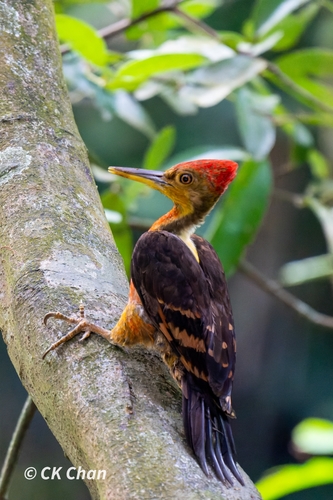
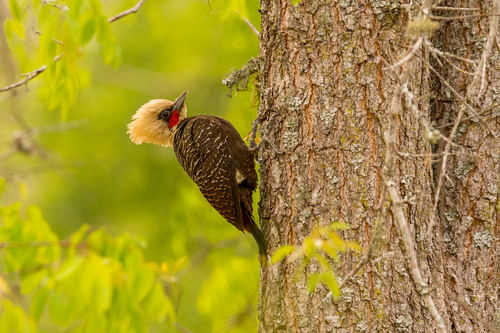
The pale-crested woodpecker (scientific name Celeus lugubris, originally described by Malherbe in 1851) measures about 23 to 24 cm (9.1 to 9.4 in) in length. The nominate subspecies C. l. lugubris weighs 115 to 130 g (4.1 to 4.6 oz), while subspecies C. l. kerri weighs 112 to 157 g (4.0 to 5.5 oz). For both subspecies, males have a wide bright red malar area and cheek, and sometimes red extending around the eye; in females, this area has brown barring or a scaly brown pattern instead. In the nominate subspecies, adult individuals of both sexes have a pale blond to buffish head, which includes the long pointed crest, chin, and throat. They have deep rufous-black upperparts, with a blond to cream-buff lower back, rump, and uppertail coverts. Their back has narrow cinnamon to pale cinnamon-buff bars; their rump sometimes has a cinnamon tinge, and the longest uppertail coverts are rufous with black bars near the tip. Their flight feathers are blackish brown with rufous bars at the base. Their tail feathers are black, with some rufous coloring and black spots on the outermost pair. Their lower neck and underparts are dark sooty rufous, with a few brighter feather edges. Their rear flanks and thighs are creamy, and the thighs have variable dark barring. Adult pale-crested woodpeckers have a grayish to horn-colored bill, a dark red to red-brown iris, and gray legs. Juveniles resemble adults, but have blackish markings on the head and irregular barring on the upperparts. Subspecies C. l. kerri is almost identical to the nominate subspecies, but is slightly larger and darker. The nominate subspecies of pale-crested woodpecker is distributed across central and eastern Bolivia, and the western portion of Brazil's Mato Grosso state. Subspecies C. l. kerri is found across most of Paraguay, in southern Mato Grosso and the state of Mato Grosso do Sul (Brazil), and in northeastern Argentina. This species lives in somewhat open landscapes including semi-deciduous forest, cerrado woodland, and dry Chaco woodlands, and it is often found in areas with palms.