About Celeus castaneus (Wagler, 1829)
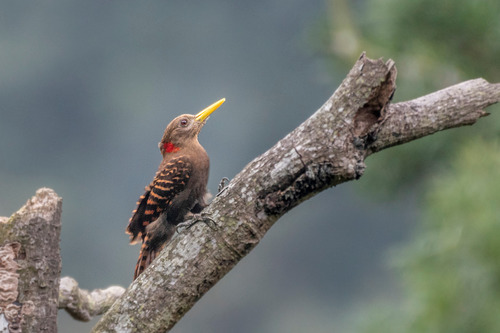
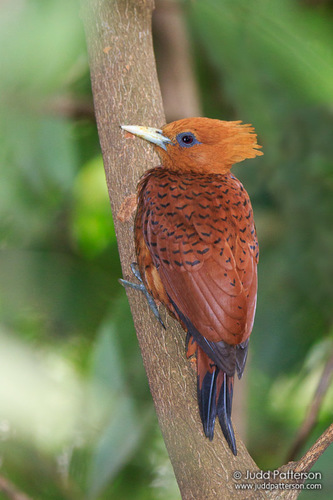
The chestnut-colored woodpecker, scientifically named Celeus castaneus (Wagler, 1829), measures 21.5 to 25 cm (8.5 to 9.8 in) in length and weighs 80 to 105 g (2.8 to 3.7 oz). Both sexes have dull ochraceous or tawny heads with a pointed crest. Males have bright red plumage extending from the lores to behind the eye, continuing down to the throat; the chin and upper throat sometimes also have some red patches. Females have no red plumage on their heads. Both adult sexes have rufous-chestnut upperparts, a cinnamon-buff rump, and black bars across the back and uppertail coverts. Their flight feathers are rufous-chestnut with some dusky brown tips. Their tail feathers are dull black with chestnut-colored bases. Their underparts are chestnut, heavily marked with black V- or U-shaped patterns. Individual birds vary in the intensity of their black markings, especially the bars on the upperparts. Adult bills are ivory-yellow with a blue-green tinge at the base, irises are chestnut or garnet brown, and legs are dark olive to grayish. Juveniles resemble adults but are duller and darker overall, with dusky mottling on the malar area, and fewer, more irregular black marks on the underparts. The chestnut-colored woodpecker is distributed along the Caribbean side of Middle America, ranging from southern Veracruz in Mexico south through Belize, Guatemala, Honduras, Nicaragua, and Costa Rica, extending just into Bocas del Toro Province in Panama. It primarily inhabits the interior and edges of humid evergreen and semi-deciduous forests, and can also be found in mangroves and coastal scrub in some areas. It favors dense foliage even when it occurs at forest edges. In terms of elevation, it ranges from sea level up to 1,000 m (3,300 ft) in Mexico, and up to 750 m (2,500 ft) in Costa Rica.