About Cedrus deodara (Lamb.) G.Don
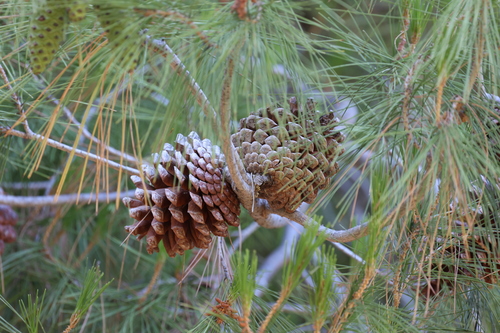
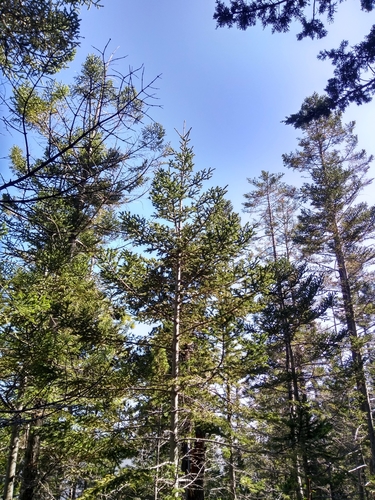
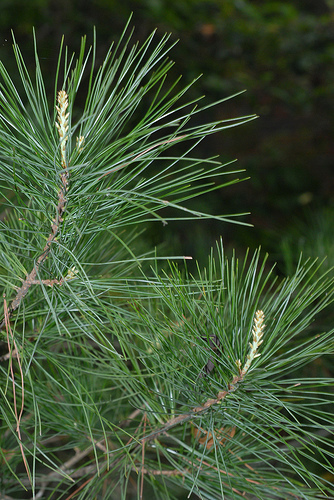
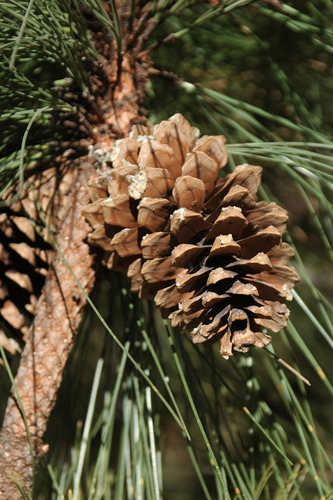
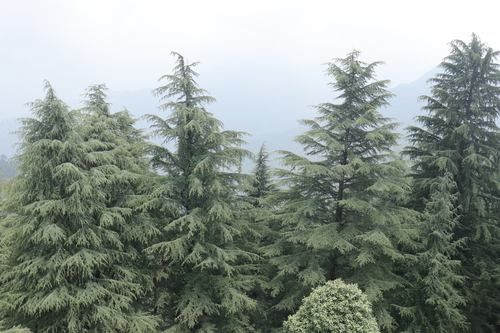
Cedrus deodara (Lamb.) G.Don is a large evergreen coniferous tree. It typically grows 40–50 metres (131–164 feet) tall, and may exceptionally reach 60 m (197 ft), with a trunk up to 3 m (10 ft) in diameter. It has a conic crown with level branches and drooping branchlets. Its leaves are needle-like, mostly 2.5–5 centimetres (1–2 inches) long, occasionally growing up to 7 cm (3 in) long, and are slender, measuring 1 millimetre or 1⁄32 in thick. Leaves are borne singly on long shoots, and grow in dense clusters of 20–30 on short shoots; their colour ranges from bright green to glaucous blue-green. Female cones of this tree are barrel-shaped, 7–13 cm (2+3⁄4–5 in) long and 5–9 cm (2–3+1⁄2 in) broad. They disintegrate when mature after 12 months to release winged seeds. Male cones are 4–6 cm (1+1⁄2–2+1⁄4 in) long, and shed their pollen in autumn.
This species is native to East Afghanistan, South Western Tibet, Western Nepal, Northern Pakistan, and North-Central India. It grows at elevations between 1,500–3,200 m (5,000–10,000 ft). Deodar is a wind-pollinated monoecious species.
It is widely grown as an ornamental tree, often planted in parks and large gardens for its drooping foliage. General cultivation is limited to areas with mild winters, as trees are frequently killed by temperatures below approximately −25 °C (−13 °F), which restricts reliable growth to USDA zone 7 and warmer. It can grow successfully in rather cool-summer climates, such as that of Ushuaia, Argentina. The most cold-tolerant trees originate in the northwest of the species' native range, in Kashmir and Paktia Province, Afghanistan. Selected cultivars from this region are hardy to USDA zone 7 or even zone 6, tolerating temperatures down to about −30 °C (−22 °F). Named cultivars from this region include 'Eisregen', 'Eiswinter', 'Karl Fuchs', 'Kashmir', 'Polar Winter', and 'Shalimar'. Of these, 'Eisregen', 'Eiswinter', 'Karl Fuchs', and 'Polar Winter' were selected in Germany from seed collected in Paktia; 'Kashmir' was a nursery trade selection, while 'Shalimar' originated from seeds collected in 1964 from Shalimar Gardens, Kashmir and propagated at the Arnold Arboretum. C. deodara along with the three cultivars 'Feelin' Blue', 'Pendula' and 'Aurea' have gained the Royal Horticultural Society's Award of Garden Merit, confirmed in 2021.