About Cecropis senegalensis (Linnaeus, 1766)
Common name: mosque swallow, scientific name: Cecropis senegalensis (Linnaeus, 1766).
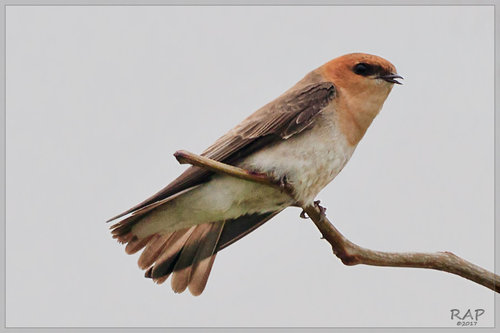
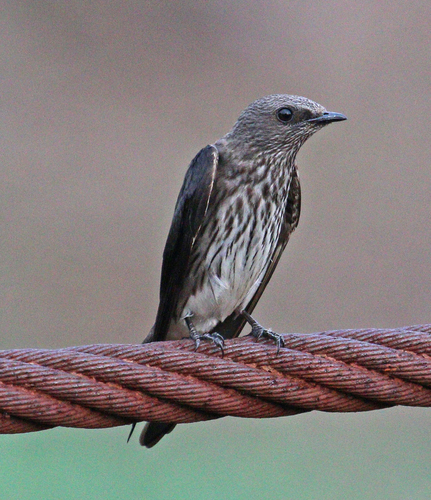
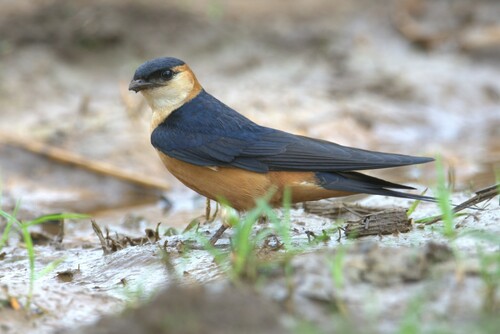
This is the largest and heaviest swallow species native to Africa, and it resembles the larger red-rumped swallow, Cecropis daurica. Its crown, upperparts, and tail are glossy dark blue; its lores and the sides of its head are whitish, forming a collar. Its rump is dark rufous, while its throat and upper breast are pale rufous, transitioning to dark rufous on the rest of its underparts. Very pale underwing coverts create a contrast with its dark flight feathers. Females look similar to males, but have shorter tail streamers. Juvenile mosque swallows are browner in color than adults. Adults measure 21–23 cm (8.3–9.1 in) in total length.
The mosque swallow occurs across Africa, ranging from southern Mauritania and Senegal east to western South Sudan, then south to Namibia, northern Botswana, Zimbabwe, Mozambique, and north-eastern South Africa. In southern Africa, it is a woodland bird that prefers dense broad-leaved woodland containing mopane (Colosphermum mopane), and also occurs in miombo woodland (Brachystegia spp) with scattered baobabs (Adansonia digitata) and leadwoods (Combretum imberbe). In West Africa, it prefers open habitats including forest clearings and savanna, and can also be found around villages and towns.
Mosque swallows feed on flying insects including ants, termite alates, and flies. They normally forage 2–30 m (6 ft 7 in – 98 ft 5 in) above the ground. They are attracted to termite emergence events and bushfires, and can gather in flocks of up to 30 birds at these events. Their flight is slow, rather falcon-like, and includes a large amount of gliding. They often forage high above the woodland canopy alongside other hirundines and swifts. They nest either alone or in small groups. Their nests are built from mud pellets, and lined with grass and feathers. Nests are shaped like a gourd, and have a long entrance tunnel attached to their side. Nests are most often placed inside tree cavities, very frequently in baobabs, but may also be placed in or under tree branches, inside buildings, or in road culverts. Breeding occurs year round, with a peak in breeding activity between August and April. The typical clutch size is 2 to 4 eggs.