About Cecropis semirufa (Sundevall, 1850)
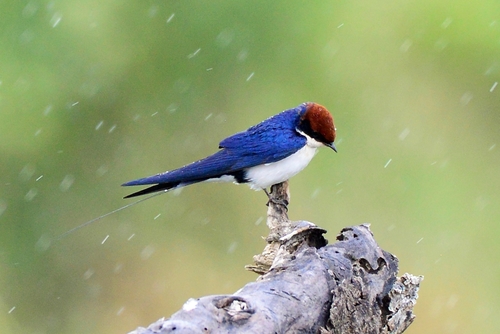
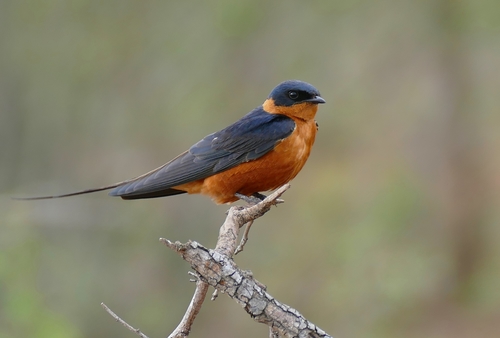
The red-breasted swallow, scientifically known as Cecropis semirufa (Sundevall, 1850), is similar to the mosque swallow but is slightly smaller and has longer tail streamers. Both species have a blue crown and mantle that contrasts with a rufous rump and underparts. In the red-breasted swallow, the dark crown extends below the eye, and there is no white on the underwing. Juvenile red-breasted swallows are similar to red-rumped swallows, but have blue on the side of the head instead of dull red. This swallow species occurs over most of Africa south of the Sahara. Its range extends from the Eastern Cape north to northern Namibia and southern Angola in the west, and to Mozambique in the east, with a separate disjunct population ranging from Senegal south to northern Angola, and east to Uganda, southwestern Kenya and northwestern Tanzania. The red-breasted swallow is migratory across most of its range. In southern Africa it is a summer visitor, nesting between July and March. Most of the southern African population migrates to equatorial Africa, although a small number of individuals remain in the region year-round. In some parts of the species' range, such as from southeastern Nigeria to Gabon, it appears to be resident. Across its northern range, it is mostly a rainy season breeding visitor. The red-breasted swallow inhabits dry open country. In more wooded areas, it is replaced by the similar mosque swallow. It builds a closed mud nest with a tubular entrance inside a cavity or under bridges and similar manmade structures. It will also use deserted buildings, tree holes or caves, and has benefited from the construction of railway bridges and similar human-built structures.