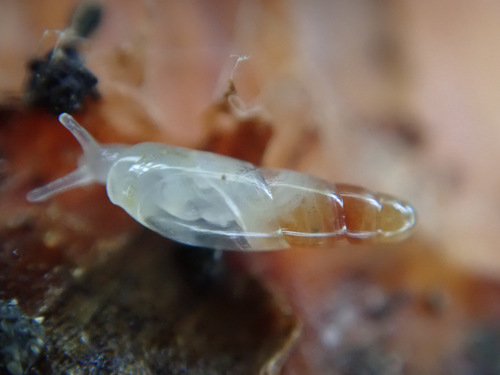
About Cecilioides acicula (O.F.Müller, 1774)
This species, Cecilioides acicula, is a small animal that is white in body color, with two pairs of tentacles and no eyes. Its shell is long and narrow, reaching a maximum size of 5.5 mm in length and 1.2 mm in width. Fresh shells are colorless, glassy, and transparent, while older, non-fresh shells become somewhat opaque and milky-white. This species lives underground, at a considerable depth below the surface. It is more commonly found in soils with high calcium content. Due to its subterranean habitat, it is most often found only as an empty shell, in locations such as mole hills, ant hills, or river flood debris. Its native distribution covers central and southern Europe, with a native range centered in Mediterranean Europe that also extends into Western Europe including Great Britain, Ireland, and the Netherlands, and Central Europe including the Czech Republic (where it is listed as least concern, LC), Poland, Slovakia, and Ukraine. It has also been accidentally introduced to a number of other regions: Latvia (since 2006), Bermuda (since 1861), Ontario in Canada, multiple states across the United States including Pennsylvania, Florida, Maryland (since 1959), Virginia (since 2006), California, New Jersey, and New Mexico, as well as New Zealand and Australia.

