About Cebus imitator Thomas, 1903
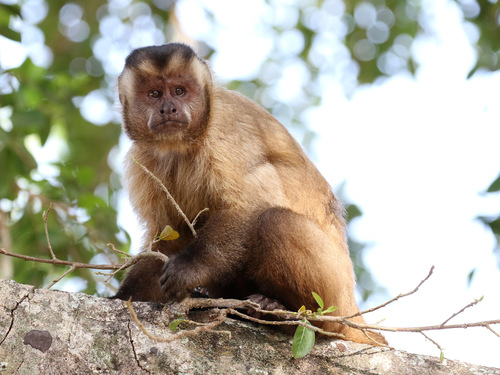
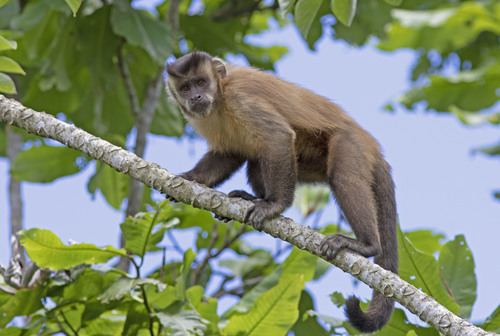
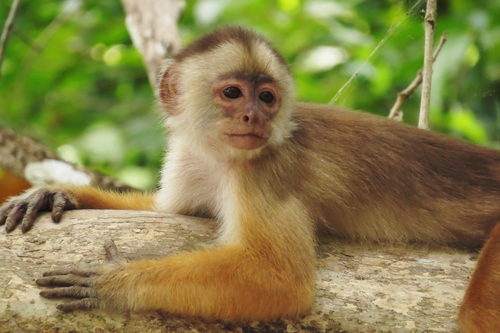
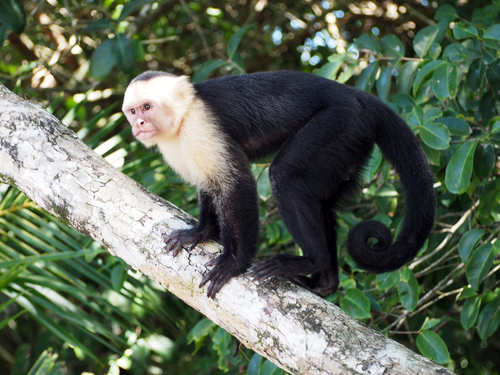
Like other monkeys in the genus Cebus, the Panamanian white-faced capuchin (Cebus imitator Thomas, 1903) gets its name from Capuchin friars: the cowls worn by these friars closely match the monkey’s head color pattern. This species has mostly black fur, with white to yellow fur on its neck, throat, chest, shoulders, and upper arms. Its face is pink or white-cream colored, and may have distinct markings including dark brows or dark fur patches. A distinctive black fur patch on the crown of the head sets it apart. It has a prehensile tail that is often held coiled, which gives white-faced capuchins the nickname "ringtail".
Adults grow to 335 to 453 mm (13+1⁄4 to 17+7⁄8 inches) long, excluding the tail, and can weigh up to 3.9 kg (8 pounds 10 ounces). The tail is longer than the body, reaching a maximum length of 551 mm (21+3⁄4 inches). Males are approximately 27% larger than females. The brain of a Panamanian white-faced capuchin weighs around 79.2 g (2+13⁄16 ounces), which is larger than the brains of several bigger monkey species, such as the mantled howler. It is very similar in appearance to the Colombian white-faced capuchin, with one key difference: female Panamanian white-faced capuchins have elongated brownish or grayish frontal tufts, which contrast with their pure white cheeks and throat.
The Panamanian white-faced capuchin lives across most of Central America. Its confirmed range covers large parts of Honduras, Nicaragua, Costa Rica, and Panama. There have been unconfirmed reports of populations in eastern Guatemala and southern Belize. It is one of the most frequently seen monkeys in Central America’s national parks, including Manuel Antonio National Park, Corcovado National Park, Santa Rosa National Park, and Soberania National Park. It is featured on the reverse side of Costa Rica’s 5,000 colón banknote. While it is very common in Costa Rica and Panama, it has been largely extirpated from Honduras and most of Nicaragua. Many capuchins from Honduras were captured and relocated to the island of Roatán, and many from Nicaragua were captured and relocated to the island of Ometepe. In Nicaragua, wild capuchins can still be easily seen in regions around Masaya, around Bluefields, and in other areas along the South Caribbean coast. Visitors climbing one of the volcanoes on Ometepe Island encounter wild individuals daily.
This capuchin inhabits many different forest types, including mature and secondary forests, evergreen and deciduous forests, dry and moist forests, plus mangrove and montane forests. It appears to prefer primary or advanced secondary forests. Higher population densities are found in older forest areas, evergreen forest areas, and areas with greater water availability during the dry season.
The Panamanian white-faced capuchin has a polygamous mating system, where one male may mate with multiple females. While the dominant troop male does not completely monopolize breeding, studies show that most offspring are fathered by dominant males. When a female mates with multiple males, dominant males are more likely to copulate with her when she is at peak fertility. Notably, dominant males tend to avoid breeding with their own daughters that are part of the troop; this type of inbreeding avoidance is rare among New World primates.
Copulation lasts approximately 2 minutes, and the gestation period ranges from 5 to 6 months. Typically a single infant is born, though twins occur occasionally. Most births take place during the dry season, between December and April. The infant is carried on its mother’s back for around 6 weeks. After 4 to 5 weeks, it can leave its mother for short periods, and by 3 months it can move independently, though some infants become mostly independent earlier. Weaning happens between 6 and 12 months of age. When the mother rests, young capuchins spend most of their time foraging or playing, either alone or with other juveniles. Capuchins practice high levels of alloparenting, where monkeys other than the mother help care for infants. Infants are most often carried by alloparents when they are between 4 and 6 weeks old, and both males and females participate in alloparenting.
Like other capuchin species, the Panamanian white-faced capuchin matures slowly. Sexual maturity can be reached as early as 3 years old. On average, females give birth for the first time at 7 years old, and produce offspring every 26 months after that. Males reach reproductive maturity at 10 years old. For its size, the Panamanian white-faced capuchin has a long lifespan; the maximum recorded lifespan in captivity is over 54 years.
Capuchins are counted among the most intelligent New World monkeys, and this species has been the subject of many studies of behavior and intelligence. Researchers think capuchin intelligence evolved to support their feeding habits, as they rely on hard-to-find ephemeral food sources. A 2007 study placed capuchins among the ten most intelligent primates, ranking them second only to spider monkeys among New World monkeys.
The use of stone tools is a clear difference between gracile capuchins (genus Cebus) and robust capuchins (genus Sapajus). While stone tool use is widespread in robust capuchins, only one case of habitual stone tool use has ever been reported in gracile capuchins. One population of Panamanian white-faced capuchins in Coiba National Park, Panama, has been observed using hammerstones and anvils to process fruits from Terminalia catappa, Bactris major, and Cocos nucifera (coconuts), as well as invertebrates including nerite snails, hermit crabs, and Halloween crabs.
Panamanian white-faced capuchins are known to rub parts of specific plants into their fur. Plants used for this behavior include citrus fruits, vines of the genera Piper and Clematis, monkey comb (genus Sloanea), dumb cane, and custard apple. They also rub ants and millipedes into their fur. The exact purpose of this rubbing behavior is not confirmed, but it may deter parasites like ticks and insects, act as a fungicide, bactericide, or anti-inflammatory agent, or serve as a form of scent marking.
This species uses tools in other ways too. It has been recorded beating snakes with sticks to protect itself or force a snake to release an infant, and it sometimes uses sticks as probes to explore openings. In captivity, it uses tools to access food or defend itself; in one documented case, a white-faced capuchin used a squirrel monkey as a projectile, throwing it at a human observer.
Due to its intelligence and tool use ability, the Panamanian white-faced capuchin can be trained to assist people with paraplegia, just like other capuchin species. It can also be trained to appear in television and movies; a well-known example is Marcel, the capuchin from the television series Friends. Historically, these monkeys were used as traditional organ grinder monkeys.