About Cebuella pygmaea (Spix, 1823)
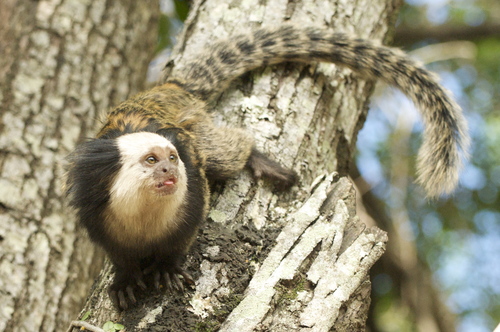
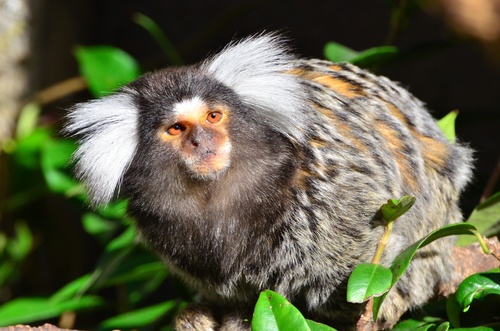
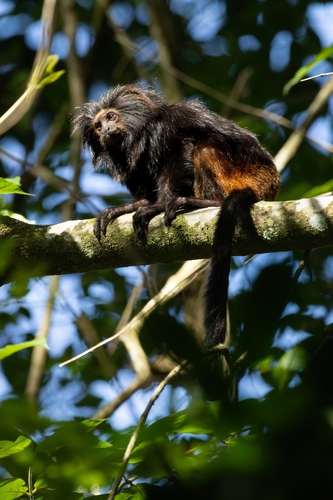
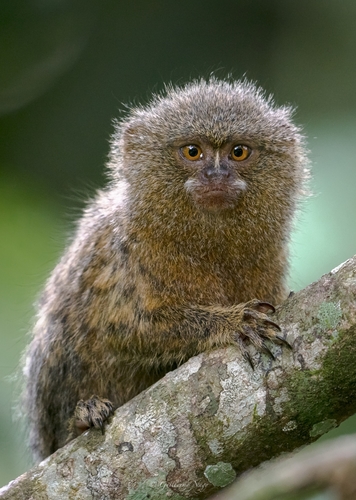
The western pygmy marmoset, with the scientific name Cebuella pygmaea (Spix, 1823), is the smallest monkey in the world. This species shows only a slight degree of sexual dimorphism. In the wild, the average male weighs 110 g (3.9 oz), which is slightly smaller than the average female, who weighs 122 g (4.3 oz). Fully grown western pygmy marmosets have an average body length of 13 cm (5.1 in). Their tail, which is marked with black rings, averages 20 cm (7.9 in) long, which is longer than their body. They have fluffy brownish-gold fur with black ticking on their shoulders, backs, and heads, while their ventral fur ranges from light yellow to white. There are very few visible physical differences between the two species in the Cebuella genus, with only a slight distinction in fur (pelage) color. Like other New World monkey species, the western pygmy marmoset has long claw-like nails on all its digits, which it mainly uses for climbing and foraging. Its skull is similar to that of the Callithrix genus, a similarity that may be linked to its tree-gouging behavior. Its appendicular skeleton is shaped by its long periods of clinging and climbing, as well as its upside-down, under-branch locomotion. Relative to their body length, pygmy marmosets can leap farther than most, but their leaps are not very efficient, so they leap rarely. Western pygmy marmosets are native to South America, with a range that crosses the borders of Bolivia, Brazil, Colombia, Ecuador, and Peru. In Brazil, they live in the upper Amazon basin, north of the Solimões River and west of the Japurá River. Their range extends south of the Río Caquetá in Colombia. A small isolated subpopulation exists west of the Rio Huallaga in northern Peru. Researchers are concerned about this small isolated population, as it is threatened by anthropogenic stresses. Western pygmy marmosets prefer lowland habitats in tropical forests that flood for more than three months each year. Accordingly, they live in tropical climate habitats including swamps and rainforests.