About Cebidichthys violaceus (Girard, 1854)
Cebidichthys violaceus, commonly called the monkeyface prickleback, reaches a maximum total length of 76 cm (30 in) and may live 18 to 19 years. The heaviest recorded individual of this species weighed just over 6 lb (2.7 kg). It is slow-growing, reaching sexual maturity between four and seven years of age, at a body length of approximately 36 to 45 cm.
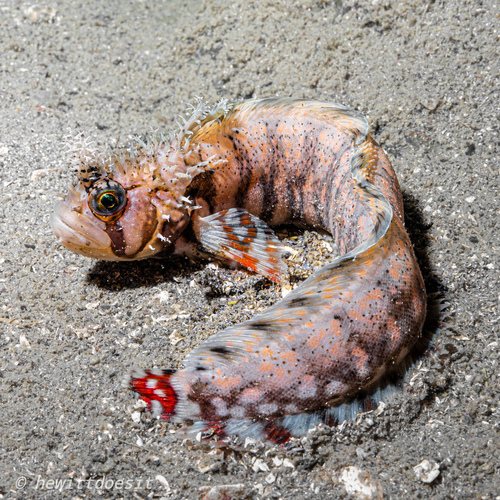
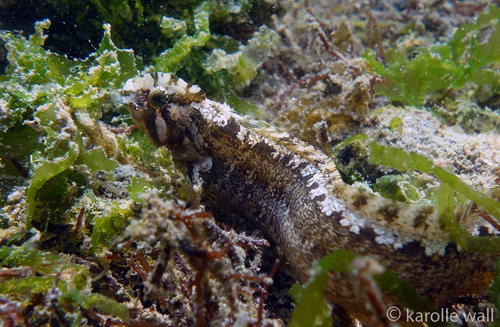
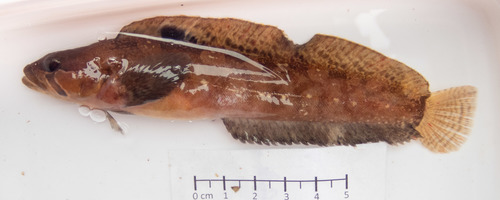
Distinguishing characteristics of C. violaceus include body color that ranges from black to brownish-green, two uniform dark stripes located below the eyes, and one or more reddish rust-colored spots on its side or belly. Coloration is similar for both sexes. This species has an anguilliform (eel-like) body shape, with large pectoral fins and two spines on the anal fin. Breeding males often develop a large fleshy lump on the top of the head.
The distribution of the monkeyface prickleback extends from southern Oregon to the northern portion of Baja California, Mexico. It is a coastal fish that lives in rocky intertidal areas close to shore, and is most abundant along the coast of central California. Its depth range spans from the upper intertidal zone down to 24 meters. Smaller individuals are commonly found in higher intertidal zones, which offer reduced predation and competition; they use rocks for protection when the tide is low. As C. violaceus grows, it moves from the high intertidal to the shallow subtidal zone.
This species is residential, meaning it only moves short distances from its hiding spots in crevices or under rocks to reach foraging sites. It tends to stay in one small area, occupying a home range of only several meters, and is mostly active during high tide when it forages.
The monkeyface prickleback lives in the intertidal zone, the most active and nutrient-rich part of the water column, where conditions constantly shift with tides, swell, and seasons. Incoming tides bring food and oxygenated water, while receding tides leave behind stagnant tidal pools with very limited resources. This species has adapted to survive in water-free holes using specialized modified gills that function both in water and out of water. As long as it remains in a moist area, it can survive out of water for approximately 35 hours.
Monkeyface pricklebacks secrete a very slick mucus through their tough, scaleless skin. This mucus protects the fish from predators, sharp rocks, and drying out. Their slender bodies let them maneuver or even slither to water puddles more easily than the related brown rockfish (Sebastes auriculatus). Through these specialized adaptations modified gills, protective mucus, scaleless skin, and a slender body the monkeyface prickleback is well-suited to survive the changing conditions of the intertidal zone.