About Ceanothus verrucosus Nutt.
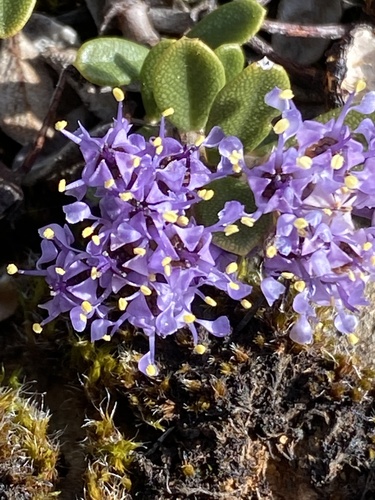
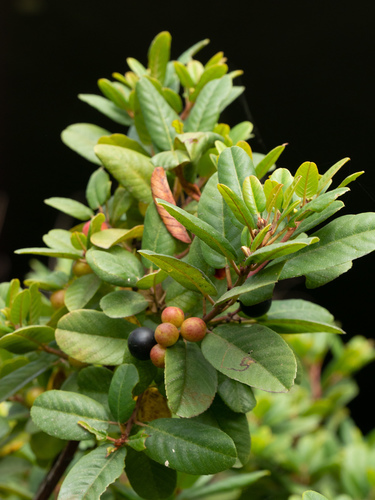
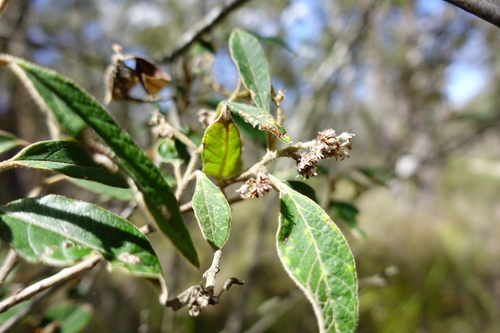
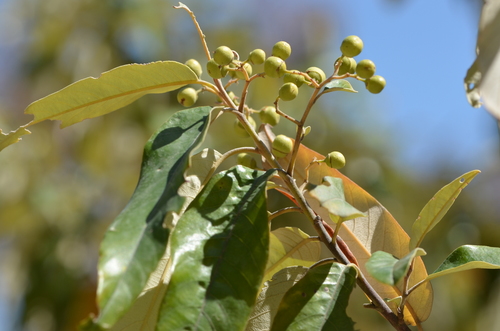
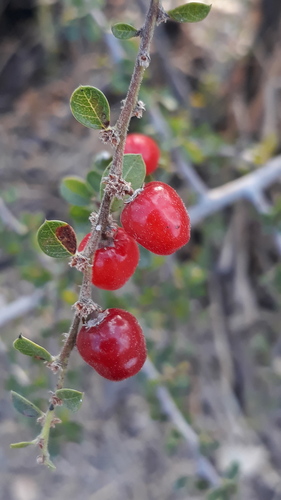
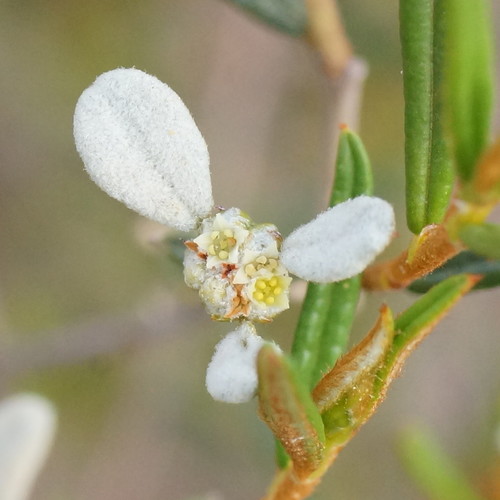
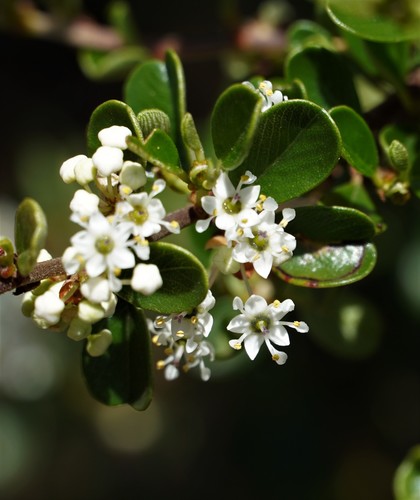
This species, Ceanothus verrucosus Nutt., is an erect, open shrub that reaches a maximum height close to 3 meters. Its stems are gray-brown, covered in fine minute hairs, and have prominent wart-like stipules at the base of every leaf. The evergreen leaves are alternately arranged; each leaf grows up to roughly 1.5 centimeters long, with a distinct blunt tip. Leaf margins are either smooth or bear 9 to 12 small teeth. Its inflorescence is a flower cluster up to 2 centimeters long. The flowers are white, with a characteristic dark center made up of the nectar disk and ovary, and they produce a mild fragrance similar to that of Alyssum. The fruit is a capsule approximately half a centimeter long. This species occurs in the United States and Mexico, specifically in coastal San Diego County, California, and northwestern Baja California. In the United States, its population is threatened by extensive coastal development, fire suppression, and activities along the international border. Of the species' previously recorded existing occurrences in the United States, five have been completely extirpated, and eight have not been observed for at least 30 years. In Baja California, the species ranges along the Pacific coast from Tijuana to the area around El Rosario, and it also grows on Cedros Island. It inhabits coastal sage scrub, southern maritime chaparral, and maritime succulent scrub habitats. Ceanothus verrucosus forms a post-fire vegetation alliance that occurs on slopes, ridges, and coastal terraces, where it often grows alongside Adenostoma fasciculatum (chamise), Cneoridium dumosum (bush-rue), Eriogonum fasciculatum (California buckwheat), Malosma laurina (laurel sumac), Rhus integrifolia (lemonade berry), and Xylococcus bicolor (mission manzanita). These plant communities are typically short-lived, and their development is shaped by periodic fire disturbance.