About Ceanothus tomentosus Parry
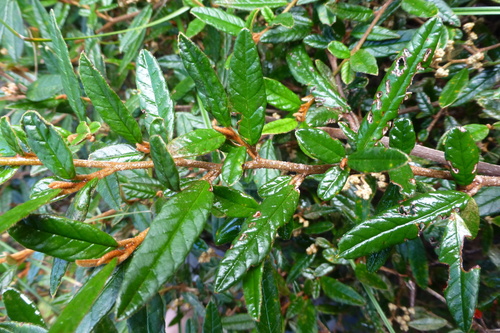
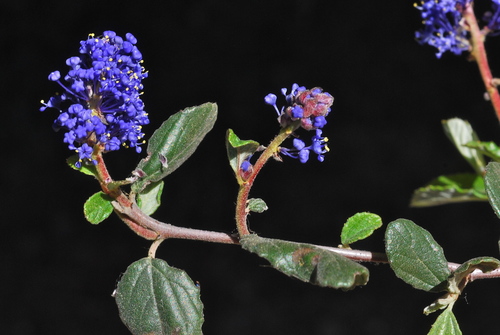
Ceanothus tomentosus Parry is an erect shrub that is occasionally tree-like, reaching a maximum height near 3 meters. Its woody structures are reddish or brown, particularly when new growth. It has evergreen leaves arranged alternately along stems, shaped elliptic to oval. The upper leaf surface is dark green with short hairs, while the underside is woolly. Leaves have a petiole 1 to 3 millimeters long; the leaf blade measures 10 to 25 millimeters long and 5 to 12 millimeters wide. Leaf margins are serrated, bearing 40 to 60 tiny glandular teeth. The inflorescence is a cluster several centimeters long, holding flowers that range from pale blue to deep blue. The fruit is a lobed capsule a few millimeters long that is sticky when new. Diagnostic features that distinguish this species from similar plants include leaves that are 3-ribbed from the base, leaf veins more or less hidden by hairs, and leaf margin teeth tipped with glands; these traits separate it from Ceanothus cyaneus. This species also has flexible, non-thornlike twigs, which differs from species such as Ceanothus leucodermis, which has rigid, thornlike twigs. This species is found in both the United States and Mexico. In the United States, it occurs in California, growing in the Peninsular Ranges of Southern California, with an additional disjunct population in part of the northern and central Sierra Nevada and its foothills. In Mexico, it grows in northwestern Baja California, ranging from Tijuana to the southern end of the Sierra de San Pedro Martir. It grows primarily on open sites including slopes, ridges, chaparral, and coniferous forest. This species was first described by Charles Christopher Parry in 1889. It is classified in the genus Ceanothus, subgenus Ceanothus. The specific epithet tomentosus refers to the dense, interwoven trichomes on the plant. While Ceanothus subgenera generally differ in whether plants resprout from lignotubers or grow from seed after fire, Ceanothus tomentosus has both resprouting and nonsprouting individuals across its range. Populations in the Sierra Nevada portion of its distribution resprout after fire, while populations in Southern California are non-sprouters. Nonsprouting populations also typically begin flowering earlier than resprouting populations.