About Ceanothus parvifolius (S.Watson) Trel.
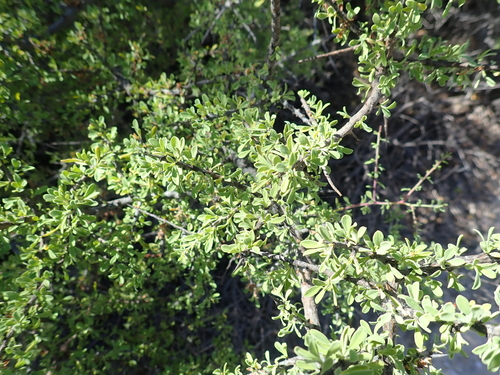
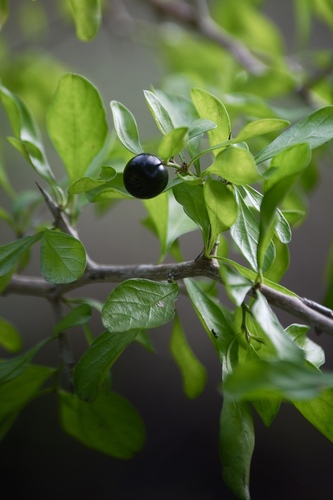
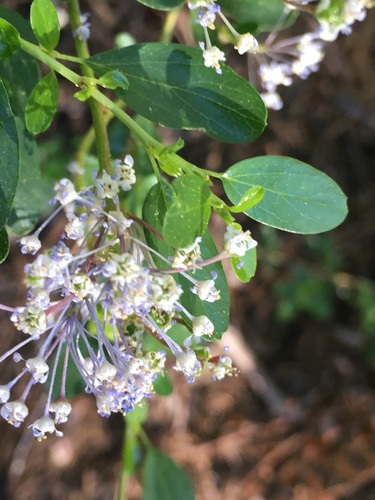
Ceanothus parvifolius (S.Watson) Trel. is a spreading shrub that reaches a maximum height just over one meter, growing into a wide bush. Its twigs are thin, green, and completely hairless, and unlike the twigs of Ceanothus cordulatus, they are flexible and not thornlike. This species bears alternately arranged deciduous leaves with scale-like stipules. The leaves measure 8 to 21 millimeters long and 3 to 12 millimeters wide, are mostly oval in shape with smooth edges, and sometimes have a few tiny teeth near the tip. Both leaf surfaces are generally hairless, the upper leaf surface is shiny, and 1 to 3 ribs are present at the base of each leaf. It produces inflorescences ranging from raceme to panicle in form: these flower clusters are 4 to 9 centimeters long and hold blooms in various shades of blue. Flowering occurs from May to July. The fruit is a smooth 3-lobed capsule a few millimeters long. This species is similar to Ceanothus integerrimus, but can be distinguished by its dwarf, spreading, often flat-topped growth habit, blue flowers (as opposed to white flowers of C. integerrimus), and much smaller leaves. Putative hybrids between Ceanothus parvifolius and Ceanothus cordulatus have been reported. This species is distributed on the western slope of California’s Sierra Nevada, ranging south from Plumas County to Tulare County. It grows primarily at elevations from 1255 to 2220 meters, found in open sites, slopes, flats, and within coniferous forests.