About Ceanothus herbaceus Raf.
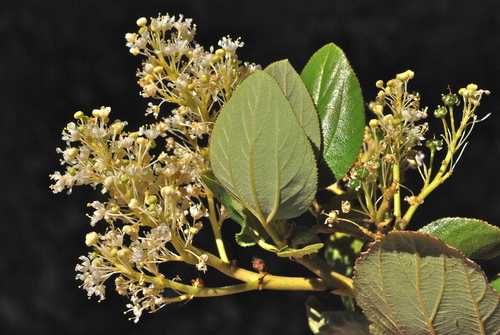
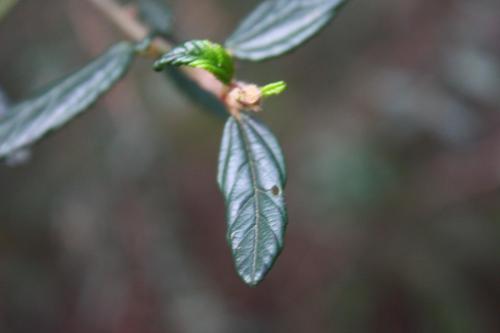
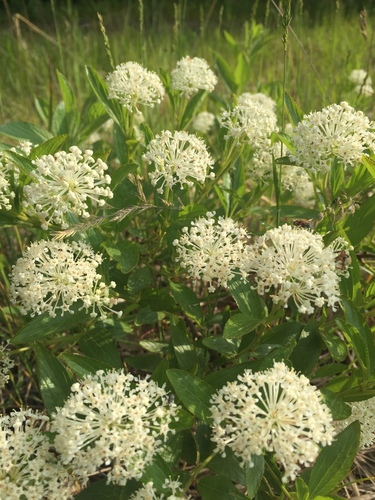
Scientific name: Ceanothus herbaceus Raf. This species is an erect shrub, growing 0.5 to 1 meter tall. It typically has a hemispheric overall shape, with branches that grow anywhere from ascending to spreading. Distal branchlets that grow from the main stem are flexible, with internodes 12–31 mm long. They are usually smooth in texture and green in color. The bark of the main stem is grayish brown. Stipules, small outgrowths on either side of the base of a leaf stalk, are thin and deciduous. Leaves are alternate and deciduous. The petiole, the structure that connects the leaf blade to the stem, is approximately 3–5 mm long. Leaf blades measure 35–74 mm long and 10–32 mm wide. Leaf shapes vary widely, from broad to narrowly elliptic to lanceolate, and taper to an acute or obtuse apex. Three veins arise unevenly just above the leaf base. Leaf margins are serrated with rounded teeth, with 37 to 71 teeth per leaf. The upper leaf surface is dull green and nearly glabrous. The lower leaf surface is also dull green, covered in long, soft unmatted hairs that often dry to a rusty brown color. This species produces a terminal inflorescence 15–30 mm long. The inflorescence is panicle-like and hemispheric in shape. A long supporting stem called a peduncle holds the inflorescence; it is typically 26–48 mm long, and usually bears a few reduced leaves near its base. The rachis, the main axis of the inflorescence, and the peduncles are puberulent to somewhat tomentulose. A pedicel, the stem that connects each individual flower to the inflorescence main axis, is 5–11 mm long and often glabrous. Ceanothus herbaceus is naturally distributed across North America. In Canada, it occurs from southeastern Manitoba to Quebec. In the United States, it ranges from Montana east to Massachusetts and Virginia; it extends south from the Rocky Mountains to New Mexico, and east to Arkansas and Louisiana. Also known as Jersey tea, this species is drought-tolerant, and its roots can grow up to 15 feet deep. It grows in well-drained soils and full sun. Its basal shoots grow faster after fire. It is a host plant for the mottled duskywing (Erynnis martialis) across the butterfly's eastern North American distribution.