About Causus rhombeatus (Lichtenstein, 1823)
Causus rhombeatus, first described by Lichtenstein in 1823, is the largest species in the genus Causus. On average, this species reaches a total length of 60 cm (24 in) including the tail. The longest recorded individual was a male measuring 93 cm (37 in) in total length, collected in eastern Zimbabwe.
The head of C. rhombeatus has a relatively blunt, more rounded snout compared to other members of its genus, with nostrils positioned on the sides of the snout. Its circumorbital ring is made up of 2–3 preoculars, 1–2 postoculars, and 1–2 suboculars that separate the eye from the supralabials. Temporal scales most commonly number 2+3, sometimes 2+4, and very rarely 2+2 or 3+3. There are 6 supralabial scales, very rarely 7. Sublabial scales most often number 7 or 10, rarely 8, and very rarely 11, 12 or 13. The first 3–4 sublabials contact the anterior chin shields; the posterior chin shields are small and often indistinguishable from the gular scales.
At midbody, C. rhombeatus has 15–21 rows of moderately keeled dorsal scales with a satiny texture. Ventral scales number 120–166, while subcaudal scales, most of which are divided, number 15–36.
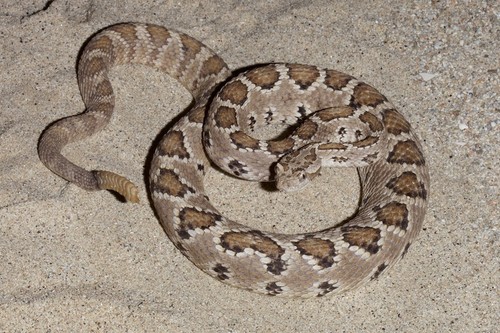
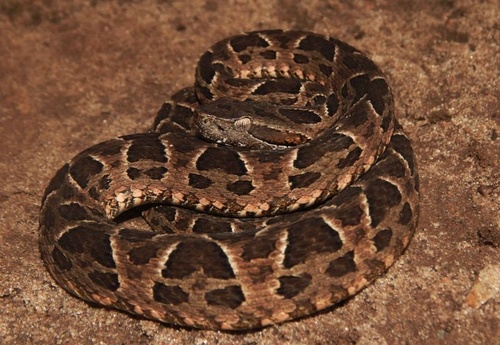
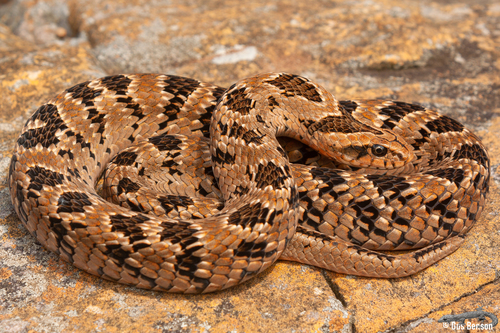
The species' color pattern has a ground color that is usually some shade of brown, which may be pinkish or grayish-brown, and is occasionally olive green. This ground color is overlaid with 20–30 rhombic blotches that have pale edges, plus scattered black scales and oblique black bars on the sides. Each oblique black bar is topped by one or two black spots that each have a pale center, and strongly resemble an eye. Northern populations of C. rhombeatus may lack any pattern, making them hard to identify. In other populations, the pale edges may be missing, the rhombic blotches may be darker, or a dark brown vertebral stripe may even be present. The head has a characteristic V-shaped mark that may be solid black, or brown with a black outline. C. rhombeatus shares a similar color pattern and behavior with the common egg-eater Dasypeltis scabra, which is thought to be an evolutionary defensive mimicry strategy.
This species is found in Sub-Saharan Africa, ranging from Nigeria east to Sudan, Ethiopia, Somalia and Kenya, and south through Tanzania, Uganda, Rwanda, Burundi, DR Congo, Angola, Zambia, Malawi, Zimbabwe, northern Botswana, Mozambique, Eswatini, and eastern South Africa, extending to Riverdale in the Western Cape Province. No type locality for the species is listed. Its preferred natural habitats are forest, savanna, shrubland, and grassland, occurring at altitudes between 600 m (2,000 ft) and 2,200 m (7,200 ft).
For reproduction, female C. rhombeatus produce an average clutch of 24 eggs. The eggs require a lengthy incubation period of approximately four months. Hatchlings measure 10–12.5 cm (3.9–4.9 in) in total length including the tail, and feed on tiny frogs and toads.