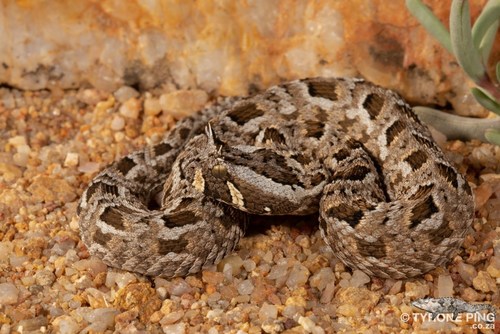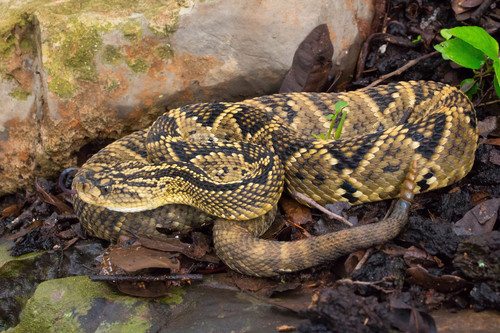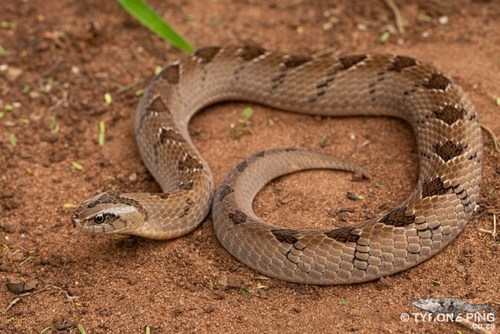
About Causus defilippii (Jan, 1863)
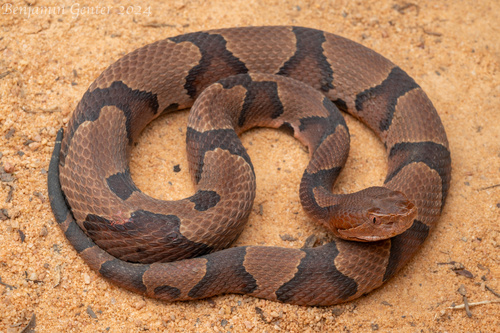
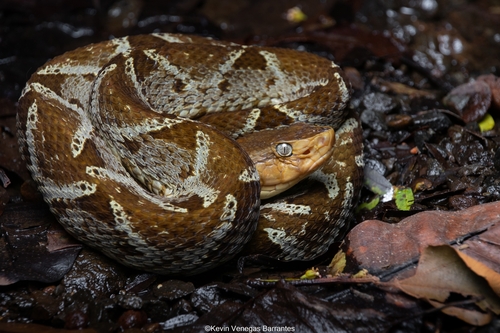
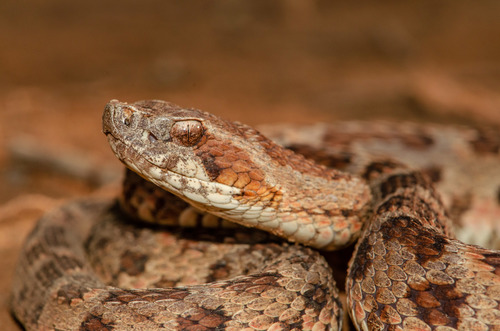
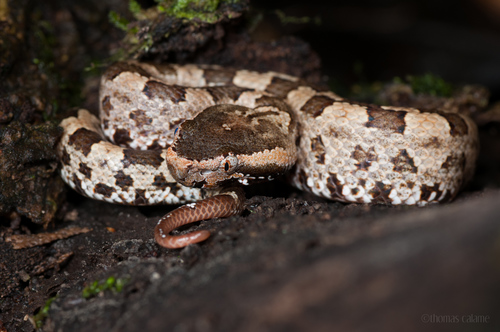
Causus defilippii, commonly known as the snouted night adder, has an average total length including the tail of 20–35 cm (8–14 inches), and rarely grows longer than 50 cm (20 inches). Its head is short and wide, with a prominent, pointed, upturned snout and a large rostral scale. The eyes are medium-sized. Its circumorbital ring is made up of 1–2 preocular scales, 1–2 postocular scales, and 1–2 subocular scales that separate the eye from the supralabial scales. In total, this species has 6–7 supralabial scales and 7–10 sublabial scales. The first 3–4 sublabial scales contact the anterior chin shields, while the posterior chin shields are very small and cannot be distinguished from other posterior scales. The temporal scales number 2+3, sometimes 2+4, and are rarely 1+2. At midbody, it has 16–18 rows of weakly keeled dorsal scales that have a velvety appearance. It has between 108 and 128 ventral scales: males rarely have more than 117, while females rarely have fewer than 118. The anal scale is single, and the number of divided subcaudal scales ranges from 10 to 19: males seldom have fewer than 14, and females seldom have more than 15. The species' color pattern has a base ground color ranging from light brown or pinkish brown to gray or grayish green, with a series of 20–30 crescent-shaped dark markings running down the back, though these markings may be indistinct. The head has a characteristic V-shaped marking with its apex on the frontal plate, plus an oblique dark streak behind the eye. The belly is yellowish, and may be uniformly colored or marked with scattered small grayish brown spots. Juvenile specimens are commonly glossy black or gray. The snouted night adder is found from Tanzania and the Democratic Republic of the Congo southward through Malawi, Zambia, Mozambique, and Zimbabwe to South Africa and Eswatini. Its original type locality was incorrectly listed as "Buenos Ayres"; this was restricted by Broadley in 1971 to Puku, Africa. Causus defilippii lives in moist and dry savanna, coastal thickets, and forests from sea level up to around 1,800 m (5,900 ft) in altitude. While it favors moist surroundings, it has also been found in dry areas on rocky hillsides and escarpments. Causus defilippii is oviparous. Clutch size ranges from six to eight eggs, each measuring 23 x 15 mm (.91 x .59 inches). Each hatchling has a total length including the tail of around 100 mm (3.9 inches).