About Caustis blakei Kük. ex S.T.Blake
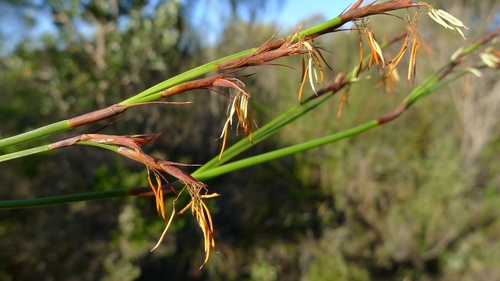
Caustis blakei is a slow-growing plant adapted to acidic, iron-rich, low-phosphorus sandy soils. It can produce dauciform roots as a morphological response to growing in soils deficient in these essential minerals. These dauciform roots work similarly to cluster roots: they exude phosphatases and carboxylates to help chemically mobilize scarce nutrients in the soil. This species grows in tall eucalyptus forests with either sparse or closed canopies, in sandy soils or soils formed from weathered sandstone. The subspecies C. blakei subsp. blakei is native to mainland Australia, ranging from Toolara in Queensland to Crowdy Bay National Park in New South Wales, with additional populations on Fraser Island, Moreton Island, and Stradbroke Island. Geographically isolated inland populations of the subspecies C. blakei subsp. macrantha have been found in Murphys Creek, Esk, and Helidon.