About Caulolatilus princeps (Jenyns, 1840)
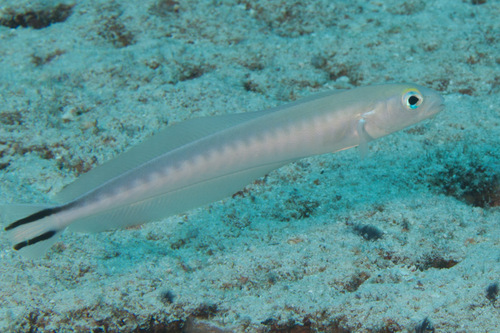
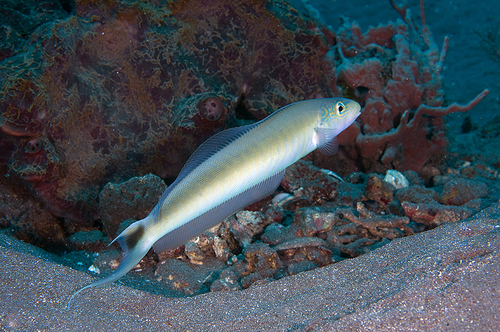
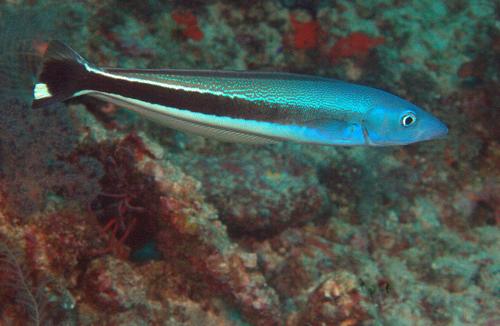
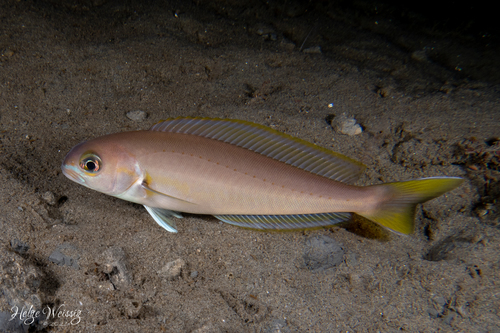
The ocean whitefish, Caulolatilus princeps, has a sturdy, quadrangular body with a relatively deep head that has a steep profile and a small mouth that extends to the front of the eye. A fleshy ridge runs along the centerline of the body in front of the dorsal fin. The gill cover bears a short blunt spine, while the preoperculum is serrated and quite sharp. The dorsal fin has 7 to 10 spines, most often 9, and 24 to 27 soft rays; the anal fin has 1 to 3 spines and 22 to 26 soft rays. Its overall body color is pale brown, with a white abdomen. The pectoral fins are greenish-blue and yellow, and the dorsal fin is yellow. This species can reach a total length of 102 centimetres (40 in). The greatest recorded weight for the species is 5.8 kilograms (13 lb), and most individual ocean whitefish weigh less than 3.6 kilograms (7.9 lb). The IGFA record for the species is a 7.74 kilogram (17.1 lb) individual caught in 2011. Ocean whitefish are found in the eastern Pacific Ocean, ranging from Southern British Columbia to Central Peru, and possibly as far south as Northern Chile. They are also present at almost all Eastern Pacific archipelagos, except for Clipperton Island. This species prefers warmer waters and is most common on the banks and offshore islands along the California coast, from Point Conception in Santa Barbara County south to Baja California, Mexico. It occurs at depths between 3 and 150 m (9.8 and 492.1 ft). It is mainly found over rocky substrates, but can also be found over sandy or muddy substrates. It is a solitary species that shelters in kelp forests or rocky reefs during the night. It is predatory, with a diet made up of crabs, shrimp, large krill, squid, anchovies, and lanternfish. It also forages by digging into the substrate. This species has an extended spawning season that lasts from late autumn to early spring. Its eggs are fertilized externally, and the larvae are pelagic until they grow larger and adopt a demersal lifestyle. Ocean whitefish reach sexual maturity at 3 to 5 years old and can live up to 13 years. Predators of the ocean whitefish include giant sea bass (Stereolepis gigas), school shark (Galeorhinus galeus), and California sea lion (Zalophus californianus). Known parasites of the species are the trematodes Choanodera caulolatili, Choricotyle caulolatili, Jaliscia caballeroi, and Myzotus vitellosus.