About Caulerpa sertularioides (S.G.Gmel.) M.Howe
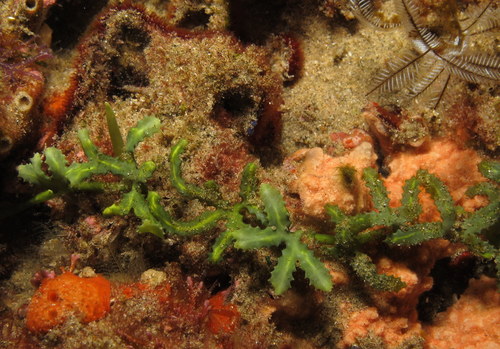
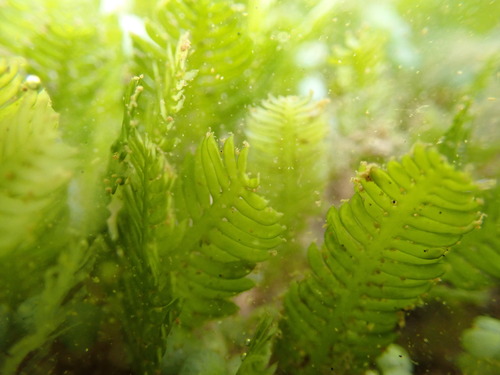
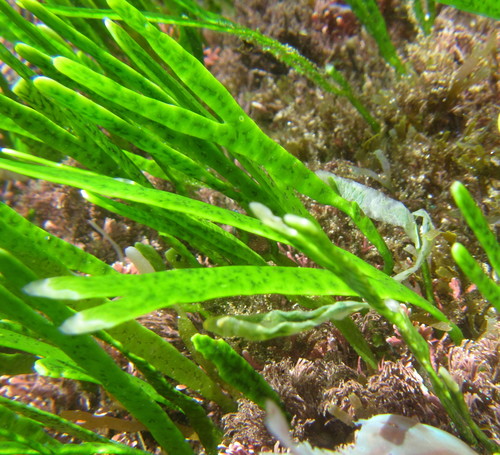
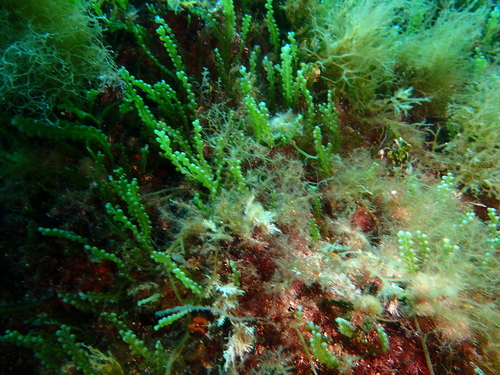
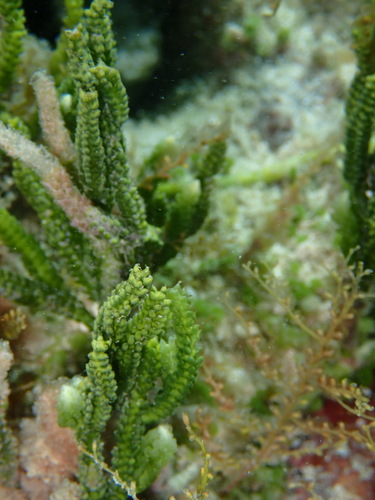
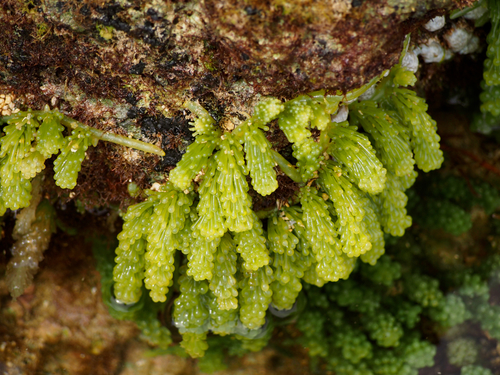
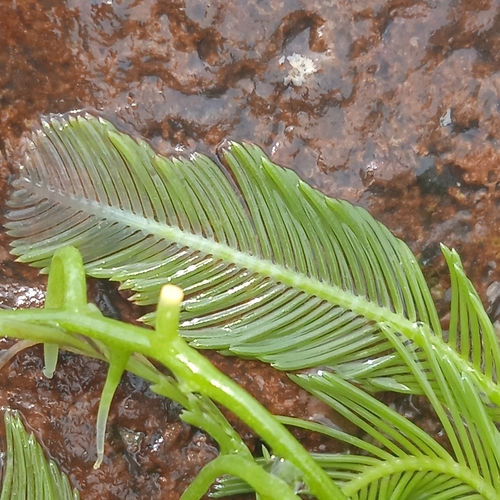
This seaweed has a pale to dark-green thallus, which generally grows 0.35 to 2 metres (1.15 to 6.56 ft) outwards. It produces feather-like fronds that emerge from a shared common stolon. Each frond grows upright and is branched. The branchlets are arranged oppositely, ranging in shape from cylindrical to needle-shaped, and have upcurved tips that end in a blunt point. Each branchlet measures 3 to 11 millimetres (0.118 to 0.433 in) in length, and attaches to a central cylindrical axis with a diameter of 1 to 1.5 mm (0.039 to 0.059 in). Each axis connects its frond to a creeping stolon that has a diameter of 2 to 2.5 mm (0.079 to 0.098 in) and can grow up to 2 metres (7 ft) long. Stolons branch out into slender points, and rhizoids form from the stolons' lower surface; these rhizoids fork, penetrate sandy substrate, and anchor the seaweed firmly to the seafloor. This species is widely distributed across tropical waters. In the United States, it occurs from North Carolina to Florida. It is also found throughout the Caribbean, around Bermuda, the Bahamas, the Greater and Lesser Antilles, in the Gulf of Mexico, and in the southern Atlantic Ocean as far south as Brazil, as cited in Taylor 1979. In the Pacific Ocean, it is found along Australia's Great Barrier Reef, in Papua New Guinea, the Philippines, and Palau. In Western Australia, it grows along the coast from the Kimberley region south to the Gascoyne. The species typically occurs in coastal and estuarine environments, growing in sandy areas such as seagrass beds, or on and around mangrove roots. It is most commonly found in shallow water, down to depths of around 10 metres (33 ft), though isolated sparse individuals have been collected from depths as great as 110 metres (361 ft).