About Caulerpa racemosa (Forssk.) J.Agardh
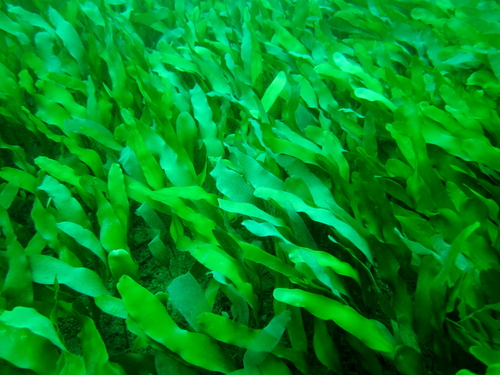
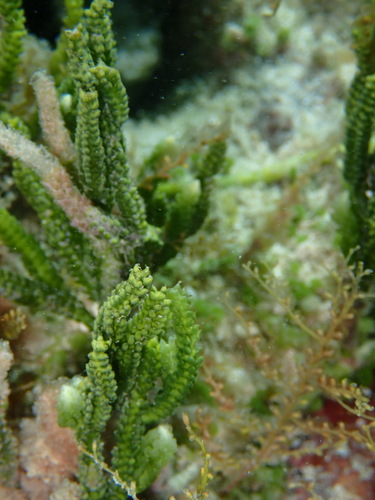
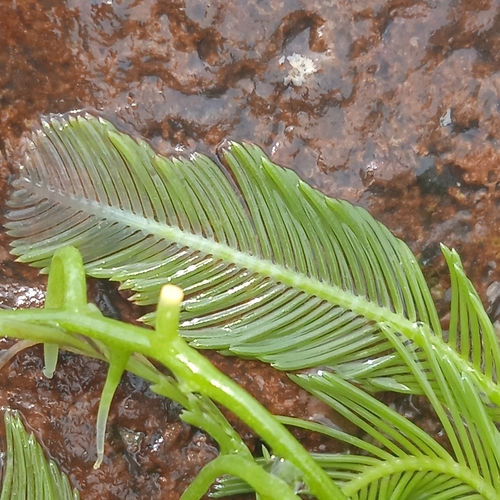
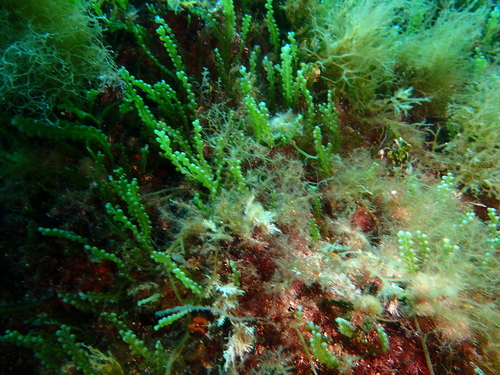
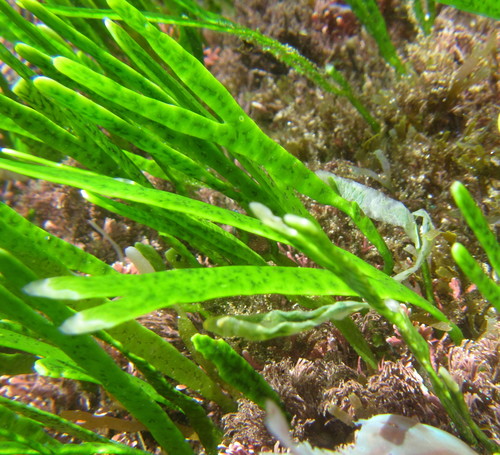
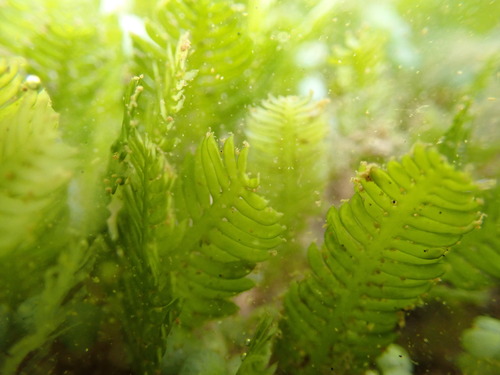
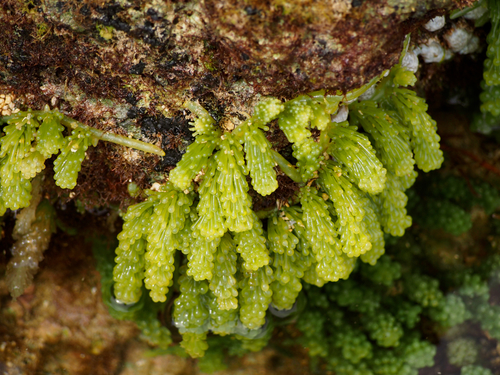
A Caulerpa racemosa individual is made up of multiple branches connected to stolons, which are anchored to sandy substrate by rhizoids. Its branches are spaced a few centimeters apart and can grow up to 30 centimeters (12 inches) tall. Many spherical or ovate side-shoots grow from these branches, giving the seaweed its common name of sea grapes. Like other members of the order Bryopsidales, each C. racemosa plant is a single enormous cell that contains many nuclei. The chloroplasts that hold chlorophyll can move freely between any parts of the organism, and a network of fibrous proteins supports organelle movement. C. racemosa is widely distributed across shallow temperate and tropical seas. In 1926, a new form of this alga was recorded off the coast of Tunisia; it was possibly an immigrant from the Red Sea, and later spread to much of the eastern Mediterranean. In 1990, a new larger form with two vertical rows of branches on opposite sides of the stem was discovered off Libya. This form spread widely, invading most of the Mediterranean and becoming more widespread than the invasive species Caulerpa taxifolia. It is known as variety cylindracea, and may have originated from Australian waters. In the Americas, C. racemosa occurs in shallow water in the Caribbean Sea, around Bermuda, and along the eastern seaboard from Florida to Brazil. Caulerpa species contain cytotoxic secondary metabolites, with caulerpenyne being the most abundant. These metabolites deter animals from eating the algae. A study examined herbivores that graze on invasive C. cylindracea meadows in the northwestern part of its Mediterranean range. Researchers found that the sea breams Boops boops and Sarpa salpa feed on this alga, as do the sea urchins Paracentrotus lividus and Sphaerechinus granularis. Other herbivores graze occasionally, but the total amount consumed is offset by the alga's rapid growth, so these grazers are unlikely to be effective for biological control of the plant. Both C. taxifolia and C. racemosa show that substratum has a strong influence on their spatial distribution, and both heavily colonize the dead matte of the seagrass Posidonia oceanica. C. racemosa and C. taxifolia are both invasive Lessepsian migrants, and C. racemosa contains less caulerpenyne than C. taxifolia. Like its close relative C. lentillifera, C. racemosa is edible. It is commonly eaten in salads in Japan, Fiji, the Philippines, and Thailand. It is also consumed by local fishermen in Malaysia and Indonesia. It is high in fiber, proteins, and minerals including calcium and magnesium, plus folic acid, ascorbic acid, vitamin A, and vitamin B1, while being low in fat. In addition to its nutritional properties, C. racemosa has antibacterial and antioxidant activity, though these properties have not yet been fully explored. These varied biological activities hint at potential future biomedical innovations. These properties are thought to come from a strain of rare endophytic actinomycetes that lives in symbiosis with C. racemosa, particularly from the secondary metabolites (flavonoids and alkaloids) the actinomycetes produce. C. racemosa extracts are currently being tested to treat different types of cancer, and to fight multi-drug resistant uropathogens such as K. pneumoniae and P. aeruginosa. Multi-drug resistance is a major public health problem; the World Health Organization (WHO) projects that by 2050, 10 million people could die each year from this antibiotic resistance in bacteria. A number of potential treatments for other conditions have also been identified, particularly for diabetes and herpes.