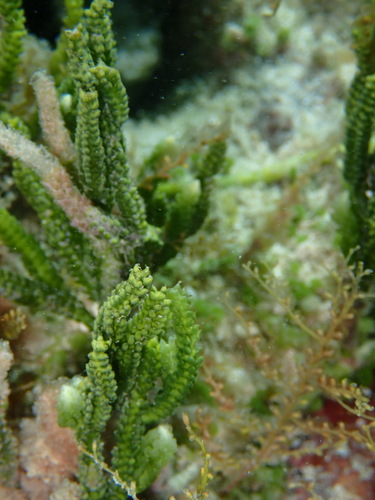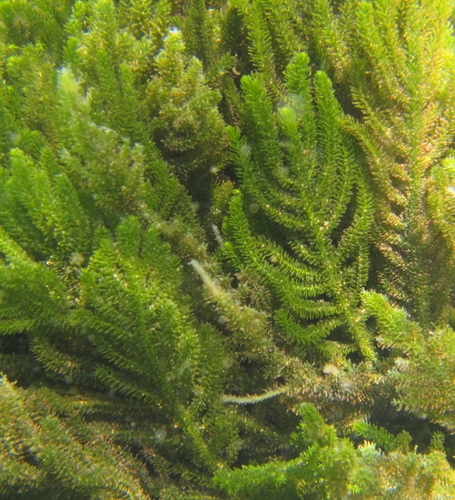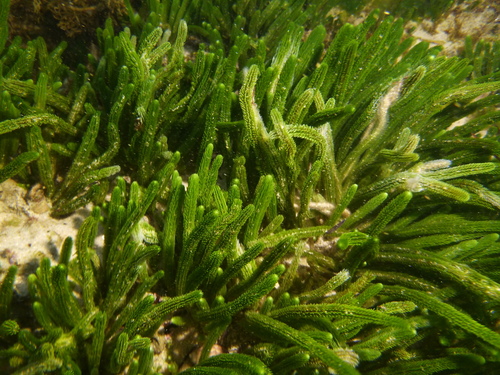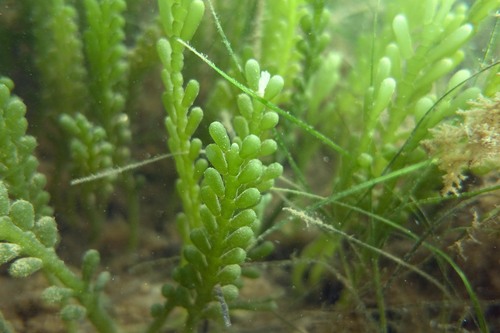
About Caulerpa prolifera (Forssk.) J.V.Lamour.
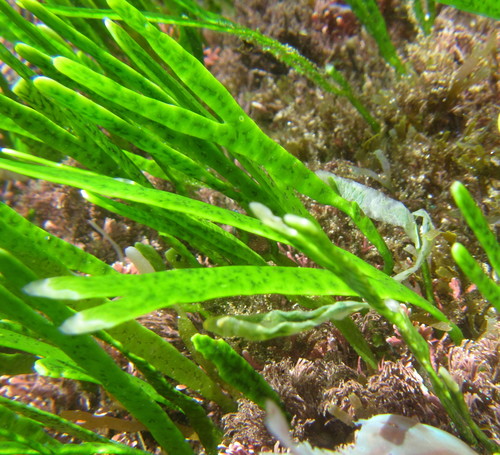
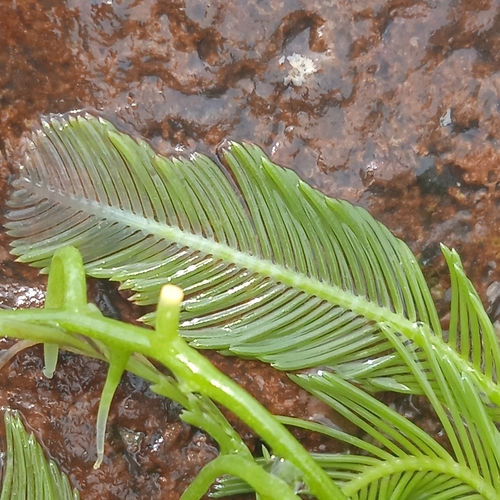
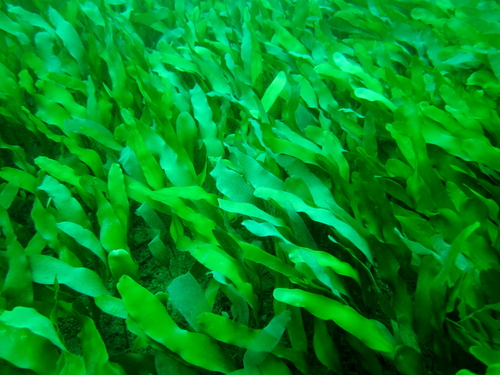
A Caulerpa prolifera individual is made up of multiple blades (also called laminae) connected by underground stolons. Rhizoids anchor the entire organism to a sandy substrate. The blades contain chlorophyll to carry out photosynthesis, though the green color of chlorophyll is partially hidden by other pigments. Like all other members of the order Bryopsidales, each C. prolifera plant is a single giant cell with multiple nuclei that forms a single individual organism. Chloroplasts can move freely between different parts of the organism in response to local light levels, and a network of fibrous proteins enables this organelle movement. Individual C. prolifera plants from the same origin still show high morphological variation, and research shows this variation is partly caused by differences in light exposure. Plants growing in bright locations grow as compact, highly branched, dense structures. In contrast, populations in shady locations typically produce longer, thinner blades that can make more effective use of limited available light. Two distinct forms of this alga are currently recognized: Caulerpa prolifera f. obovata (J.Agardh) and Caulerpa prolifera f. zosterifolia (Børgesen). C. prolifera is distributed in shallow European waters, the Mediterranean Sea, the warm eastern Atlantic Ocean, the eastern seaboard of the United States, Mexico, Brazil, and certain other scattered locations.