About Caucasotachea vindobonensis (C.Pfeiffer, 1828)
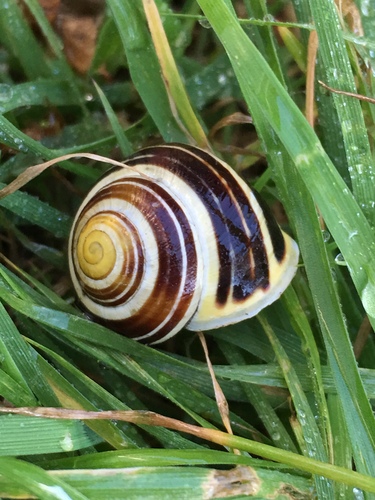
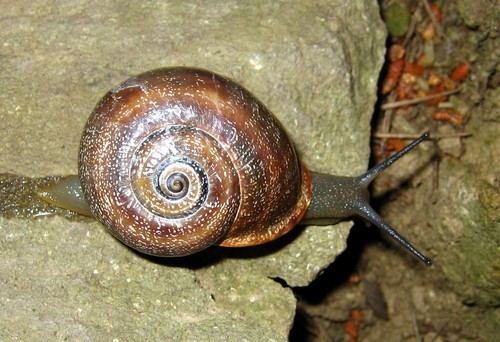
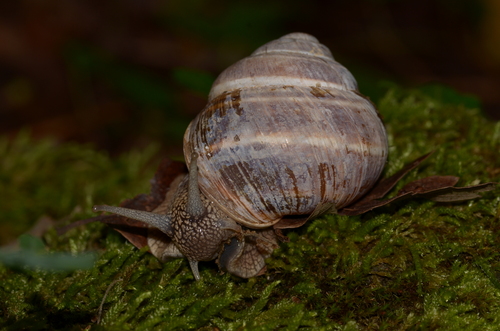
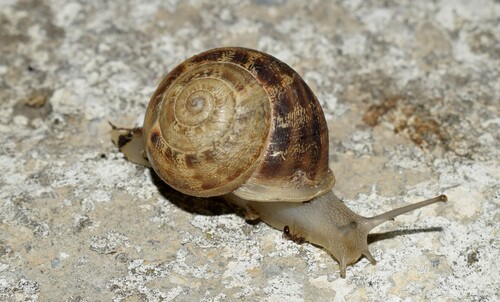
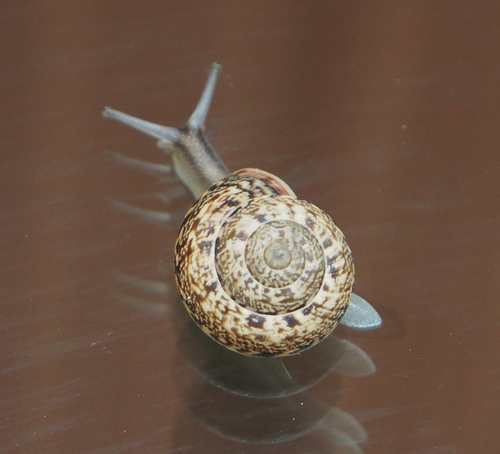
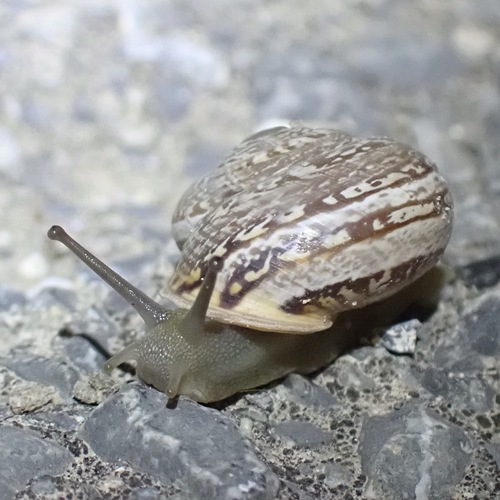
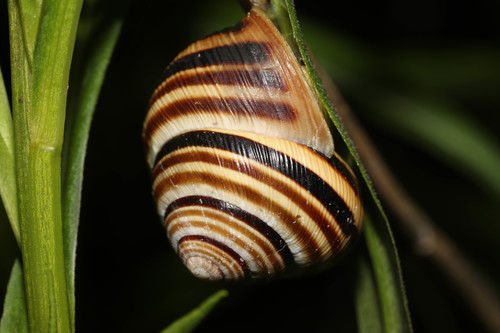
The right-coiled, globular shell of Caucasotachea vindobonensis measures 17–21 mm in height and 20–25 mm in breadth, with 5.5–6 whorls. In adult individuals, the umbilicus is completely covered. The lip of the shell is brown at its inner end and fades to pale towards the suture; this feature distinguishes C. vindobonensis from the morphologically similar species Cepaea hortensis, which usually has a pure white lip, and Cepaea nemoralis, which usually has a dark brown lip, both of which C. vindobonensis often co-occurs with. A second key difference is that the shell of C. vindobonensis bears fine growth ridges, while the shells of Cepaea species are smooth. The shell of C. vindobonensis is whitish or yellowish, and typically marked with 5 brown stripes, where the upper two stripes are usually faint. The lowermost stripe is positioned closer to the columella than it is in Cepaea species. There is minor variation in shell color within this species. The soft body of the snail is yellowish, with grey tentacles.
C. vindobonensis is native to the Pontic, Pannonian, and Balkanian regions. It occurs naturally in Albania, Austria, Bulgaria, Bosnia and Herzegovina, Croatia, the Czech Republic (where it is classified as near threatened, NT), Germany (where it has been reintroduced), Greece, Hungary, Italy, Latvia, Moldova, Poland, North Macedonia, Romania, Slovakia, Russia (native in Rostov Oblast, Stavropol Krai, and Krasnodar Krai; introduced in Moscow Region), Serbia, Slovenia, and Ukraine. Introduced populations have been recorded in the United States (New York State) since 2015, and in Canada (Quebec) since 2020. The species' original habitat was most likely open forests in the Balkans, from which it spread across large areas of Central and Eastern Europe after the last glaciation. It also lives in a range of grassland habitats including meadows, steppe, and ruderal areas, especially in the northern portion of its range. The highest elevation at which it has been recorded is approximately 1600 m above sea level in southern Bulgaria.
All information about the life cycle of this species comes from a study conducted in Greece, which lies at the southernmost edge of the species' distribution, so the phenology of C. vindobonensis may differ considerably in more northern parts of its range. C. vindobonensis reaches sexual maturity after its second year and can live up to a maximum of 7 years. Its reproductive season runs from April to June, peaking in May. Each year, adult snails lay around 50 eggs, each about 3 mm in diameter. Juveniles hatch from the eggs after 18 days. During hot summer weather, these snails rest attached to leaves or stems of tall plants. Hibernation begins between late October and early November, and snails emerge from hibernation in March.