About Catostylus mosaicus (Quoy & Gaimard, 1824)
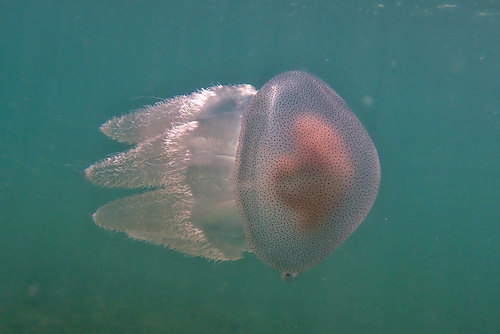
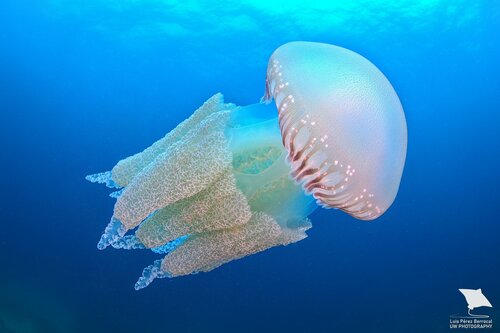
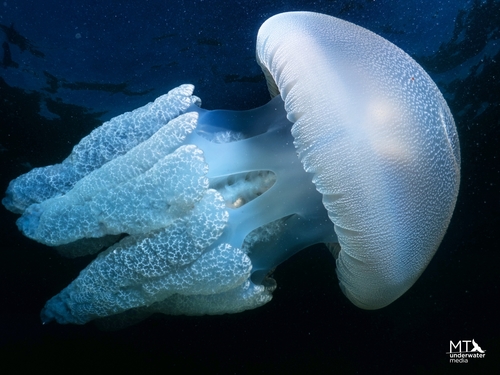
Catostylus mosaicus (Quoy & Gaimard, 1824), commonly called the jelly blubber, belongs to the class Scyphozoa and order Rhizostomae. Members of this order are distinguished by the absence of tentacles; instead, their bodies have four oral lobes and eight arms that attach to the center of the bell. The bell of C. mosaicus is spherical, and its feeding structures make up a larger proportion of its body than in many other jellyfish species. Its unique bell shape allows C. mosaicus to use jet propulsion, which is driven by contraction and relaxation of the bell. Stinging nematocyst cells are located on the arms of C. mosaicus, and are used for both defense and immobilizing prey. Because nematocyst characteristics differ between jellyfish species, they are often used for species identification. Different nematocyst types are specialized to catch different prey, which may contribute to the specialized diets seen in jellyfish. C. mosaicus has four distinct types of nematocysts: Oval Isorhizae, pear-shaped Isorhizae, Rhopaloids, and Birhopaloids. These nematocysts occur in relatively high abundance, and enable the species to capture prey and defend itself. Two monophyletic subspecies clades of C. mosaicus are recognized in Eastern Australia: C. mosaicus mosaicus and C. mosaicus conservitus. These two subspecies differ in mitochondrial DNA, color, and morphological traits including general body proportions and bell depth. C. mosaicus mosaicus occurs in New South Wales and southern Queensland, and can be identified by its small or absent papillae and larger bell diameter. C. mosaicus conservitus is found in Bass Strait, and can be distinguished by its conspicuous papillae, blue or white body color, and smaller bell. C. mosaicus is the most common large medusa along the coastline of Eastern Australia, and is also found along the Malay Peninsula. It inhabits estuaries, semi-enclosed lagoons, and shallow bays, and can form large, dense blooms. This species thrives in high salinity environments. Lowered salinity events inhibit planula settlement and reduce the feeding ability of medusae, while rapid salinity changes impair osmoregulation and cause the jellyfish to swell or shrink quickly. As a result, C. mosaicus is found mostly in the higher salinity areas of estuaries. C. mosaicus feeds primarily on zooplankton, specifically mollusc veligers, copepods, and copepod nauplii. It generally captures fewer gelatinous zooplankton, late-stage developed fish larvae, and crab megalopae, as these animals are more able to evade capture. Large blooms of C. mosaicus affect both competing species and zooplankton prey in the areas they inhabit. Blooms negatively impact zooplankton: zooplankton are consumed at higher rates, or are forced to expend extra energy to avoid capture, leading to reduced feeding and survival. Competition with C. mosaicus for food can also cause population declines in competitor species such as fish. C. mosaicus populations are controlled by predation from sea turtles and jellyfish-eating fish, including tuna, butterfish, sunfish, and spiny dogfish. C. mosaicus can recycle inorganic nutrients, providing nutrition for primary producers. Because it hosts lower amounts of symbiotic photosynthetic zooxanthellae, C. mosaicus can recycle higher amounts of inorganic nutrients than many other estuarine scyphozoans. The life cycle of C. mosaicus matches that of other members of the order Rhizostomeae. These jelly blubbers alternate between two main life stages: a sexually reproducing, free-swimming medusa stage, and an asexually reproducing, benthic polyp stage. The polyp stage reproduces asexually, while the medusa stage reproduces sexually. Medusae are gonochoristic, with a 1:1 ratio of females to males. After fertilization, the eggs of C. mosaicus develop into elongated, pelagic planula larvae. The larvae settle on the benthos and develop into the polyp stage. Polyps reproduce asexually through strobilation, which produces an ephyra, a juvenile stage that matures into an adult medusa.