About Catostomus occidentalis Ayres, 1854
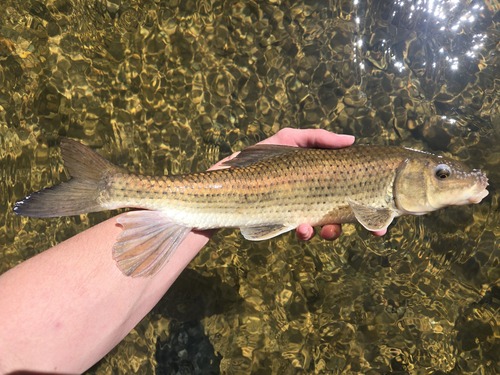
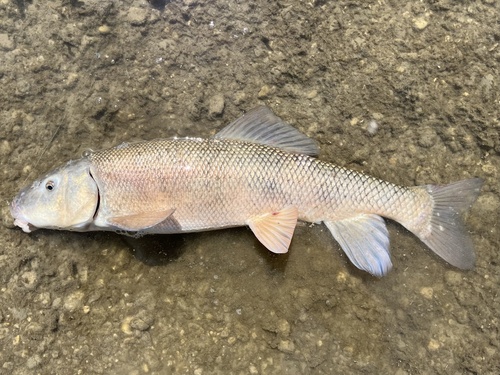
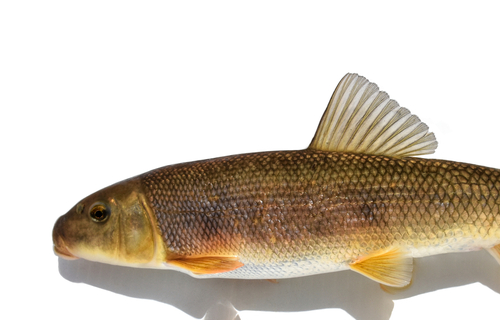
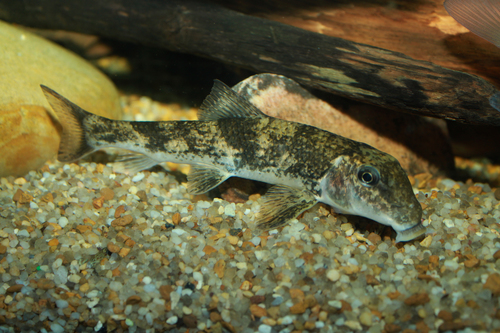
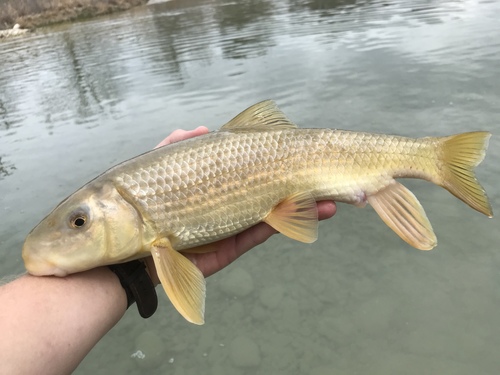
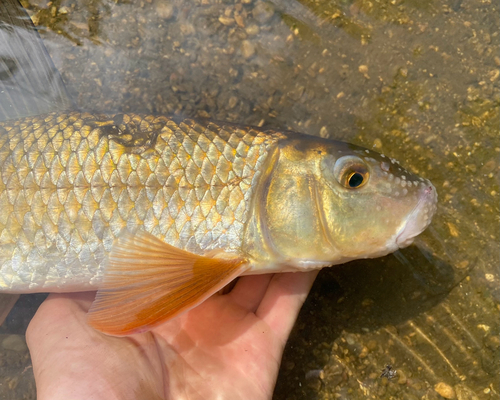
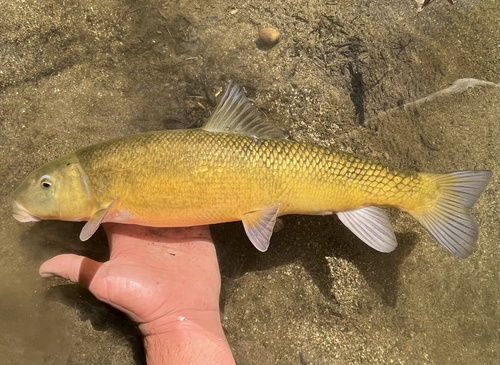
Catostomus occidentalis, commonly called the Sacramento sucker, has distinct coloration that differs by age. Adult individuals have brown or black upper bodies, and yellow, gold, or white underparts. Juvenile fish are gray, darker along the dorsal side, and have multiple spots across their bodies. Key field identifying features include a slender conical head with a terminal mouth and medium to large lips. The lips are a defining characteristic: they are covered in sensitive papillae that are largest in the middle rows, with 7 rows of papillae on the upper lip and 9 rows on the lower lip. On the head, eyes are positioned in the posterior half, and the fish has a small number of gill rakers. It has paired ventral pectoral and pelvic fins, plus an anal fin, all adapted for stability and steering. Scales are largest on the posterior half of the body, and the dorsal fin measures between 0.50 and 0.53 millimeters in length. Other notable anatomical traits include a straight lateral line, a homocercal caudal fin, and 12 to 13 caudal fin rays. Adult body length varies based on the fish’s specific habitat, ranging from 12 to 87 millimeters with an average length of 40 millimeters. Males and females grow at the same rate, but fully mature females are larger than mature males. In 1973, ichthyologist and emeritus professor John D. Hopkirk of Sonoma State determined this species is endemic to the Sacramento-San Joaquin province, and identified four subspecies: Central Valley C. occidentalis occidentalis, Eel River C. occidentalis humboldtianusi, C. occidentalis lacusanserinus from the Columbia River system, and C. occidentalis mniotilus from Monterey Bay. Additional subspecies were later identified in Clear Lake, Russian River, and Tomales Bay. In 1987, California Fish and Game (now California Fish and Wildlife) researched morphological differentiation between subspecies of Catostomus occidentalis. The agency found that regional subspecies populations do not differ significantly, with the exception of the Pajaro sucker (C. o. mniotilus), which differs from other subspecies in the number of lateral line scales, the structure of lateral line scales, and the number of scale rows before the dorsal fin. The Sacramento sucker is a host to several species of trematode flukes belonging to the family Lissorchidae and the genus Triaganodistomum. This species is native to the California Central Valley and also occurs in Oregon. In Hopkirk’s publication Endemism in Fishes of the Clear Lake region of Central California, published in University of California Publication in Zoology, he notes that morphological traits of this species such as scale density vary across geographic distributions due to hydrographic patterns. For example, C. occidentalis mniotilus has coarser scales than the nominate subspecies. The full geographic range of Catostomus occidentalis covers central and northern California, as well as parts of Oregon. Specifically, it can be found in the Sacramento-San Joaquin drainages, streams and reservoirs of the upper Oregon Goose Lake basin, the upper Kern River drainage in the San Joaquin and Tulare region, and coastal locations including Tomales Bay, and the Mad, Bear, Eel, Navarro, Russian, Pajaro, and Salinas Rivers. Sacramento suckers live in deep pools, undercut banks, or clear streams in river ecosystems, in waters ranging from cool to warm temperatures between 20 and 25 degrees Celsius. They occupy elevations between 200 and 600 meters.