About Catopyrops ancyra (Felder, 1860)
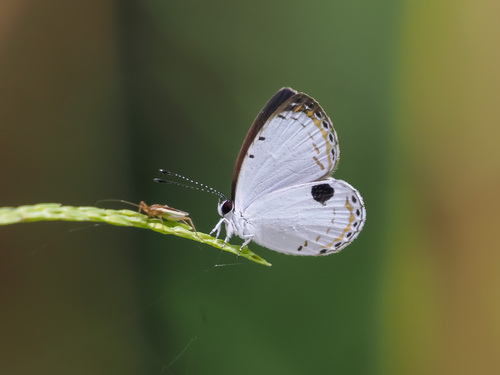
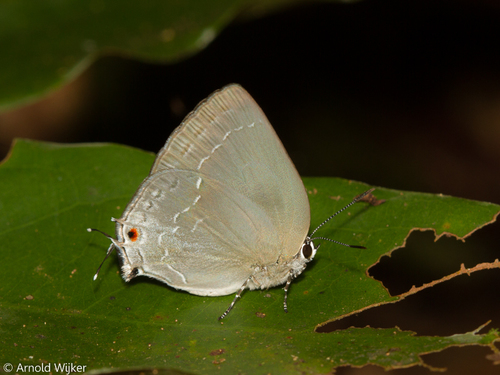
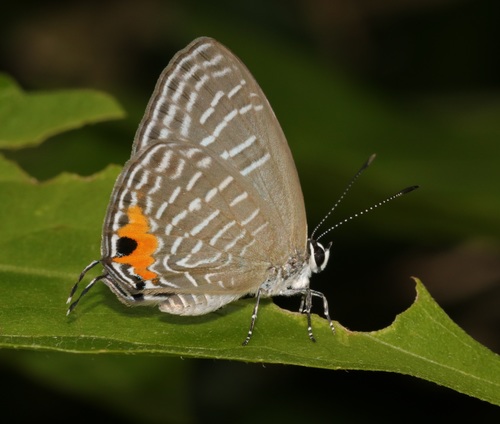
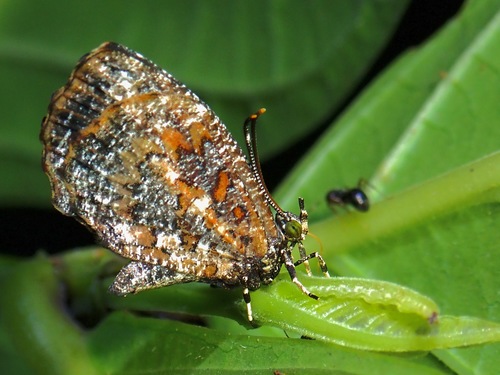
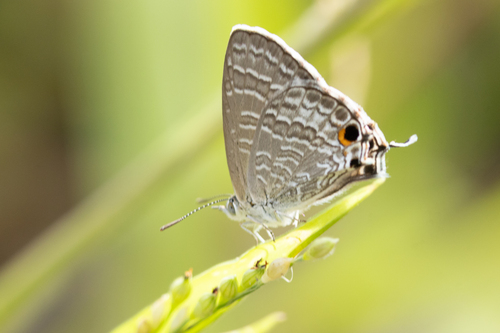
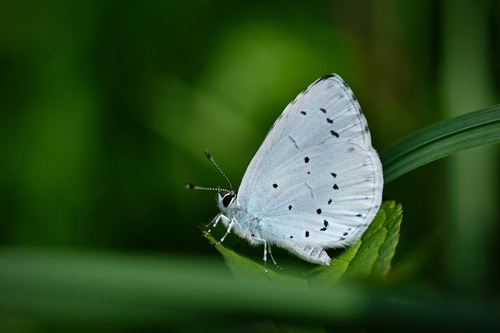
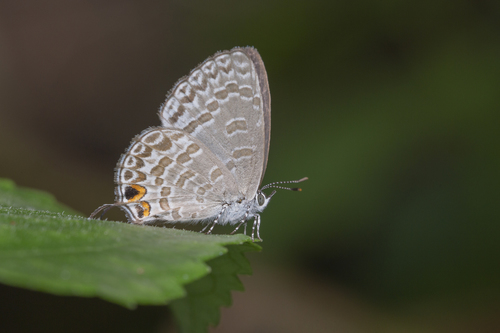
This species is scientifically named Catopyrops ancyra (Felder, 1860). For male individuals: The upper wing surface is plumbeous blue. Both forewings and hindwings have jet-black anteciliary lines. On the hindwing, there are subequal black subterminal spots in interspaces 1 and 2, beyond which lies a terminal white thread that does not extend past these two interspaces. The lower wing surface is French grey; main markings are chalky white and somewhat diffuse. On the forewing, there is a pair of short transverse white lines across the middle, and another pair at the apex of the cell, one on each side of the discocellulars. This latter pair of lines does not extend to the apex, but in most specimens, two white spots mark their position at the apex. A complete transverse catenulated discal band, formed by two parallel white lines, is present; beyond this band, the ground colour appears as if it has been chalked over. Terminal markings are blurred, and consist of an inner and an outer transverse series of white lunules, followed by an anteciliary white line. The ground colour is distinctly darker between the transverse pairs of medial and discal white lines, and between the subterminal series of lunules. Between the subterminal lunules and the anteciliary line, the ground colour forms an incomplete transverse row of dark spots. On the hindwing, the following somewhat indistinct transverse white markings are present: two basal lines, a single line on the inner side of the discocellulars, two irregular discal lines, followed by double series of white lunules. There is a white anteciliary line and a subterminal row of dark spots, matching those on the forewing. Subterminal black spots in interspaces 1 and 2 have broad ochraceous orange margins on their inner side. The tail is black with a white tip. The antennae, head, thorax, and abdomen are dusky brown; the antenna shafts are speckled with white, and the thorax and abdomen are suffused with blue. On the underside, the palpi, thorax, and abdomen are white. For female individuals: The upper wing surface is fuscous black. On the forewing, the posterior two-thirds are pinkish brown with an iridescent blue sheen, there is a jet-black anteciliary line, and cilia are dark brown. On the hindwing, the basal three-quarters have a duller, paler blue sheen than that of the forewing. There is a very obscure postdiscal series of slender pale lunules, followed by dark ground colour, and beyond that a subterminal series of slender lunules: the lunules in interspaces 1 and 2 are ochraceous orange, and all others are white. There is a series of jet-black spots, a slender terminal white line, and a conspicuous jet-black anteciliary line. Cilia are white, alternating with dark brown at the vein apices. The lower wing surface is similar to that of the male, but the ground colour is paler, and all markings, especially terminal markings, are more clearly defined. The antennae, head, thorax, and abdomen match the male in appearance. This species is distributed across the hills of Assam, Myanmar and Tenasserim, as well as the Nicobar Islands.