About Catophractes alexandri D.Don
Catophractes alexandri is the only species in the genus Catophractes, a member of the plant family Bignoniaceae. It grows as a spiny shrub or small tree reaching up to 3 m in height. This species occurs in hot, low-rainfall regions of Namibia, the Northern Cape, the Kalahari Desert, Botswana, western Zimbabwe, and Limpopo. It prefers calcrete, limestone outcrops, and limestone soils, and often forms pure stands. When not growing alone, it typically associates with Colophospermum mopane, Rhigozum virgatum, Phaeoptilum spinosum, and Acacia nebrownii. It is parasitized by several species of the genus Tapinanthus.
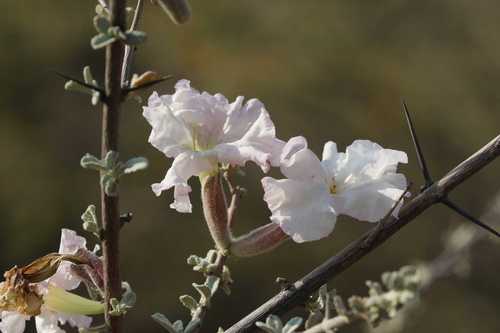
Its specific epithet alexandri honors James Edward Alexander, a Victorian soldier and explorer. The generic name refers to the fact that the plant’s leaves and flowers emerge from below its paired, decussate, opposite spines. Its leaves are either tufted (fascicled) or opposite, are densely grey-tomentose, simple, and elliptic to obovate in shape. They grow up to 4 cm long, with coarsely dentate or scalloped margins.
After rain events, the plant produces fragrant, showy 5-lobed flowers that are roughly 10 cm long. Flowers are white or pink, with a yellow throat. Inside the flower tube, there is a broad, villous band below the point where the stamens attach. The calyx is tubular, has linear teeth, and is slit along one side.
The fruit of Catophractes alexandri is a flattened, woody capsule around 10 cm long, with a warty surface. The capsule dehisces across its flat faces into two equal parts. Mature old fruits hang downward, and the two hollow halves tap against one another like castanets, producing a distinctive clicking sound in light wind. Seeds of this species are papery and winged.
This species was first formally described in publications from 1839: "Ann. Nat. Hist." ii. 375, and "Proc. Linn. Soc." i. 4. Later descriptions appeared in "Trans. Linn. Soc." xviii. (1841) 307, t. 22; "DC. Prodr." ix. 233; Kuntze in "Jahrb. Bot. Gart. Berl." iv. (1886) 270; Engl. in "Engl. Jahrb." x. 255; and K. Schum. in "Engl. & Prantl, Pflanzenf." iv. 3B, 233.
This species has several documented medicinal uses. The root is chewed to treat stomach complaints. When combined with the root of Polygala leptophylla Burch., it is prepared as a decoction to treat abdominal pain, especially in children. Infusions and decoctions made from the leaves, roots, and bark are used to treat colds and coughs.